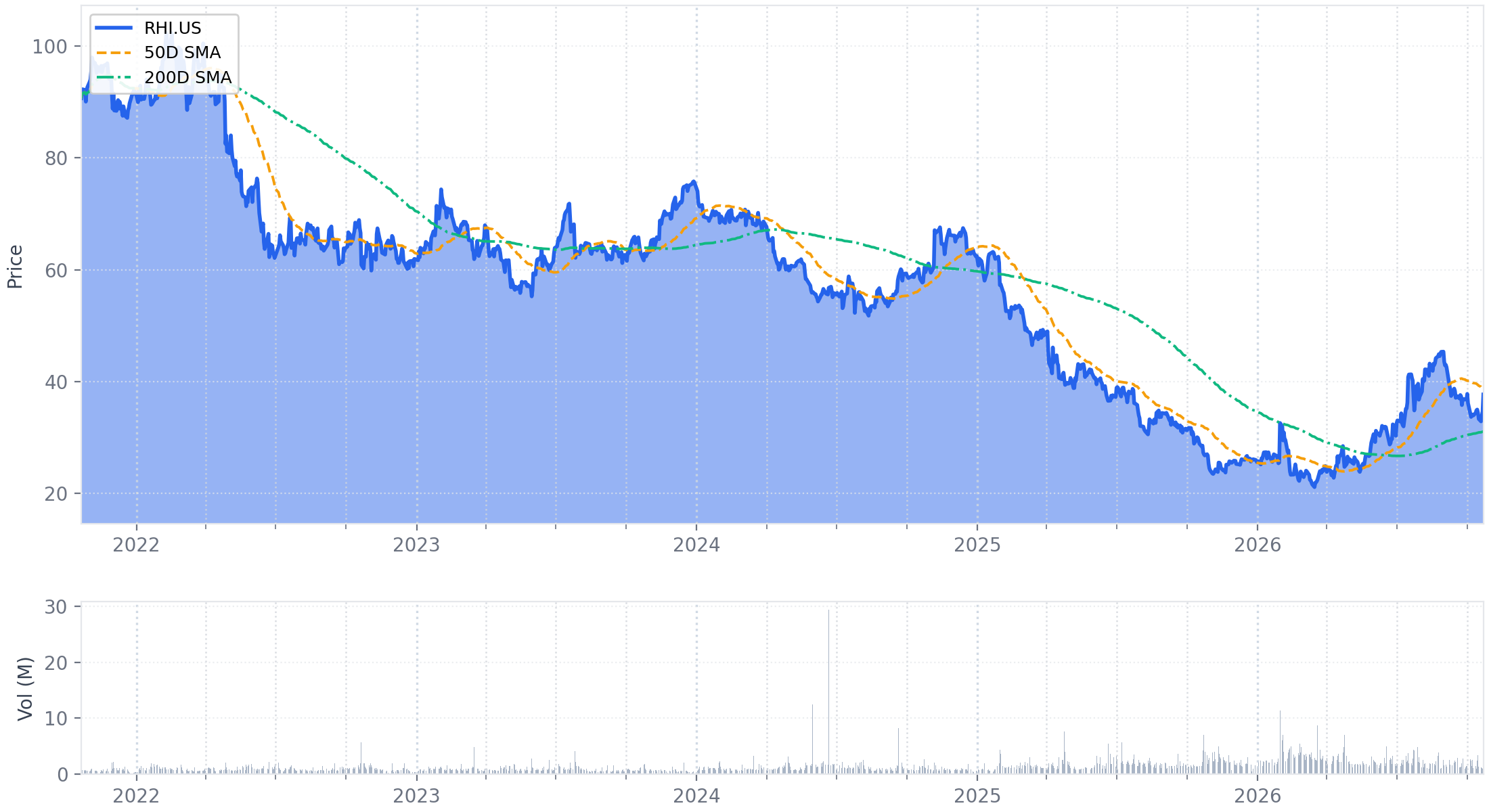
Executive Summary
Robert Half reported third-quarter service revenues of $1.359 billion (roughly flat at -0.2% adjusted YoY), meeting management guidance, while diluted earnings per share reached $0.49, up 14.0% year-over-year to beat the guidance midpoint of $0.48. This performance marked the enterprise's first quarterly year-over-year earnings expansion since 2022. Results were driven by Talent Solutions returning to adjusted growth (+1.6% YoY) and Protiviti exceeding top-line guidance after U.S. Treasury Department enforcement actions spurred an immediate surge in Anti-Money Laundering (AML) remediation projects.
Operational stabilization broadened across divisions. Within Talent Solutions, permanent placement grew 5.6% adjusted YoY, while Contract Talent bill rates increased 3.6% on a constant-mix basis. Protiviti adjusted revenues declined 3.3%, outperforming guidance of -4.0% to -8.0%, supported by record quarterly technology consulting revenues alongside the risk and compliance rebound. For the fourth quarter, Q4 EPS is guided up 30.0% at midpoint ($0.41) on 3.0% adjusted revenue growth, reflecting operational leverage and the ongoing flow-through of $11 million in quarterly payroll restructuring savings.
For investors, operating leverage is beginning to emerge as regulatory compliance mandates reverse consulting headwinds and core staffing inflects. Sustaining this recovery, however, requires underlying contract hours worked to join bill rates in positive territory, alongside operating cash flow expansion to restore coverage of the $59.0 million quarterly dividend.
1. Financial Performance Summary
Robert Half reported third-quarter revenues of $1.359 billion, up 0.4% on a reported basis (roughly flat at -0.2% on an adjusted basis), meeting management's guidance of $1.31B–$1.41B. Diluted earnings per share reached $0.49, an increase of 14.0% year-over-year that exceeded the $0.48 guidance midpoint and marked the company's first quarterly year-over-year earnings expansion since 2022. Results were underpinned by a return to adjusted revenue growth in Talent Solutions (+1.6% adj. YoY), led by operating margin recovery in permanent placement, while Protiviti contracted 3.3% adjusted YoY, beating guidance of -4.0% to -8.0% due to record technology consulting revenues and a demand rebound for AML remediation engagements.
A. Income Statement Metrics
| Metric | Q3 2026 | Q3 2025 | Change (%) | Notes |
|---|---|---|---|---|
| Service Revenues | $1,359.3M | $1,354.5M | +0.4% | Met guidance of $1.31B–$1.41B; roughly flat (-0.2%) on an adjusted basis[1]. |
| - Total Talent Solutions[2] | $875.8M | $856.3M | +2.3% | Met guidance of +1.0% to +5.0% adjusted YoY; grew +1.6% adjusted[1]. |
| -- Contract Talent Solutions | $758.8M | $746.2M | +1.7% | Up 1.0% on an adjusted basis[1]. |
| --- Finance and Accounting | $565.6M | $553.4M | +2.2% | Up 1.5% adjusted YoY[1]; returned to positive year-over-year growth. |
| --- Administrative and Customer Support | $154.4M | $158.7M | -2.7% | Down 3.1% adjusted YoY[1]. |
| --- Technology | $165.1M | $157.9M | +4.6% | Up 3.9% adjusted YoY[1]; top-performing practice group. |
| --- Elimination of Intersegment Revenues[3] | $(126.2M) | $(123.7M) | +2.0% | Up 1.7% adjusted YoY[1]; contract talent deployed on Protiviti engagements. |
| -- Permanent Placement Talent Solutions | $116.9M | $110.1M | +6.2% | Up 5.6% on an adjusted basis[1]. |
| - Protiviti | $483.5M | $498.1M | -2.9% | Beat guidance of -4.0% to -8.0% adjusted; fell -3.3% adjusted[1] on an AML remediation surge. |
| Gross Profit (GAAP) | $532.1M | $504.2M | +5.5% | Gross margin was 39.1% vs. 37.2% in Q3 2025 (+190 bps). |
| Adjusted Gross Profit[4] | $531.4M | $514.7M | +3.2% | Met guidance of 38.0%–40.0% with adjusted margin of 39.1% vs. 38.0% in Q3 2025. |
| - Contract Talent Adjusted Gross Margin | 39.3% | 38.9% | +40 bps | Met guidance of 38.0%–40.0%; supported by higher spreads and conversions. |
| - Permanent Placement Adjusted Gross Margin | 99.8% | 99.8% | Flat | Direct placement revenue carries minimal direct costs of services. |
| - Total Talent Solutions Adjusted Gross Margin | 47.4% | 46.7% | +70 bps | Driven by skill mix shifts and bill-pay spread expansion. |
| - Protiviti Adjusted Gross Margin | 24.1% | 23.0% | +110 bps | Met guidance of 22.0%–25.0%. GAAP Protiviti margin was 24.2% vs. 20.9%. |
| Operating Income (GAAP) | $74.8M | $13.6M | +450.8% | Operating margin was 5.5% vs. 1.0% in Q3 2025 (+450 bps). |
| Adjusted Operating Income[5] | $72.6M | $61.2M | +18.5% | Met guidance of 4.0%–6.0% with adjusted margin of 5.3% vs. 4.5% in Q3 2025. |
| - Talent Solutions Adjusted Operating Income | $35.3M | $24.0M | +47.0% | Margin of 4.0% vs. 2.8% in Q3 2025. Met guidance of 3.0%–5.0%. |
| - Protiviti Adjusted Operating Income | $37.3M | $37.2M | +0.2% | Margin of 7.7% vs. 7.5% in Q3 2025. Met guidance of 6.0%–8.0%. |
| Net Income (GAAP) | $49.9M | $42.9M | +16.2% | Net margin was 3.7% vs. 3.2% in Q3 2025 (+50 bps). |
| Diluted EPS (GAAP) | $0.49 | $0.43 | +14.0% | Beat guidance midpoint of $0.48 within guided range of $0.43–$0.53. |
Footnotes
- Non-GAAP adjusted revenue growth rates remove the impacts of billing day variations (64.6 billing days in Q3 2026 vs. 64.2 days in Q3 2025) and foreign currency exchange rates.
- Total Talent Solutions revenue is a calculated metric representing the sum of Contract Talent Solutions ($758.8M) and Permanent Placement Talent Solutions ($116.9M).
- Intersegment eliminations represent revenues from contract talent professionals assigned to Protiviti client engagements under blended business solution agreements.
- Adjusted Gross Profit and Adjusted Gross Margin reflect the reclassification of investment income/loss on employee deferred compensation trusts to cost of services to mirror changes in deferred compensation liabilities. GAAP Gross Profit was $532.1M (39.1%) in Q3 2026 and $504.2M (37.2%) in Q3 2025.
- Adjusted Operating Income reconciliation: Adjustments reflect the combining of investment gains/losses from deferred compensation trusts with corresponding changes in deferred compensation obligations. In Q3 2026, GAAP Operating Income of $74.8M was reduced by $2.3M of deferred compensation adjustments to arrive at Adjusted Operating Income of $72.6M. In Q3 2025, GAAP Operating Income of $13.6M excluded $47.6M of deferred compensation investment gains, yielding Adjusted Operating Income of $61.2M.
B. Balance Sheet Highlights
Robert Half maintained an unencumbered balance sheet with $321.3 million in cash and cash equivalents and zero funded debt, preserving an active net cash position of $321.3 million. Disclosed liquid current assets (cash and accounts receivable) totaled $1.147 billion against total current liabilities of $1.440 billion, while total assets less current liabilities stood at $1.410 billion. Accounts receivable concluded the quarter at $826.2 million, driving Days Sales Outstanding (DSO) down to 54.8 days from 55.8 days in the prior-year period. Stockholders' equity stood at $1.209 billion, down 6.0% year-over-year as dividend disbursements exceeded net earnings.
| Metric | September 30, 2026 | September 30, 2025 | Change (%) | Notes |
|---|---|---|---|---|
| Cash and Cash Equivalents | $321.3M | $365.3M | -12.0% | Unencumbered balances; down sequentially from $324.7M at June 30, 2026. |
| Total Funded Debt[1] | $0.0M | $0.0M | — | Company carries zero short-term or long-term bank borrowings or notes. |
| Net Cash Position[2] | $321.3M | $365.3M | -12.0% | Equal to cash and cash equivalents due to debt-free capital structure. |
| Accounts Receivable, net | $826.2M | $838.0M | -1.4% | Implied DSO improved to 54.8 days vs. 55.8 days in Q3 2025 and 55.4 days in Q2 2026. |
| Total Current Liabilities | $1,439.8M | $1,364.9M | +5.5% | Accounts payable, accrued compensation, and deferred compensation liabilities. |
| Stockholders' Equity | $1,209.0M | $1,286.1M | -6.0% | Reflects YTD dividend distributions of $179.8M exceeding net earnings. |
| Total Assets | $2,849.5M | $2,846.4M | +0.1% | Current liabilities represent 50.5% of total assets. |
Footnotes
- Total Funded Debt includes commercial paper, revolving credit facilities, and long-term debt obligations. Robert Half maintains an undrawn credit facility and carries no funded debt liabilities.
- Net Cash Position is a calculated metric: Cash and cash equivalents ($321.3M) minus Total Funded Debt ($0.0M) = $321.3M.
C. Cash Flow Analysis
For the nine months ended September 30, 2026, Operating Cash Flow was $94.0 million[1] (down 31.4% year-over-year from $137.1 million in 9M 2025), with the third quarter generating $66.0 million compared to $77.0 million in Q3 2025. Capital Expenditures declined 24.7% YTD to $46.9 million, yielding $47.1 million of GAAP Free Cash Flow (reported as Net cash flows before financing activities). Standalone Q3 capital expenditures were $(15.1 million), meeting quarterly guidance of $10M–$20M. While quarterly operating cash flow covered the quarterly dividend of $59.0 million, cumulative nine-month dividend outlays of $179.8 million exceeded YTD free cash flow, prompting management to pause share repurchases during the third quarter ($0.0 million vs. $20.0 million in Q3 2025).
| Metric | 9M 2026 | 9M 2025 | Change (%) | Notes |
|---|---|---|---|---|
| Operating Cash Flow[1] | $94.0M | $137.1M | -31.4% | Q3 standalone OCF was $66.0M vs. $77.0M in Q3 2025 and $109.0M in Q2 2026. |
| Capital Expenditures[2] | $(46.9M) | $(62.2M) | -24.7% | Q3 capex was $(15.1M), meeting guidance of $10M–$20M. |
| Free Cash Flow (GAAP)[3] | $47.1M | $74.8M | -37.0% | Matches Net cash flows before financing activities. Q3 FCF was $50.9M vs. $55.6M in Q3 2025. |
| Dividend Payments | $(179.8M) | $(179.5M) | +0.2% | Maintained $0.59 per share quarterly dividend ($59.0M paid in Q3 2026). |
| Share Repurchases (Net) | $(6.8M) | $(92.1M) | -92.6% | Zero repurchases in Q3 2026; 5.6M shares authorized under current plan. |
Footnotes
- Operating Cash Flow for the nine-month period is a calculated metric derived from SEC filing data: Net Cash Flows Before Financing Activities ($47.15M) minus Capital Expenditures ($(46.86M)) = $94.01M. Standalone Q3 2026 Operating Cash Flow was $66.0M as reported by management on the conference call.
- Capital Expenditures includes capitalized cloud computing implementation costs. Full-year 2026 guidance was updated to $60M–$70M ($15M–$20M planned for Q4 2026). Standalone Q3 2026 capex was $(15.1M), calculated as 9M 2026 Capex ($(46.9M)) minus 6M 2026 Capex ($(31.8M)).
- Free Cash Flow (GAAP) is calculated as Operating Cash Flow ($94.0M) minus Capital Expenditures ($46.9M) = $47.1M, which equals Net cash flows before financing activities in the 8-K filing. Standalone Q3 2026 GAAP FCF was $50.9M ($66.0M Operating Cash Flow less $15.1M Capex) compared to $55.6M ($77.0M OCF less $21.4M Capex) in Q3 2025.
D. Key Financial Ratios
Profitability and asset efficiency metrics improved sequentially, highlighted by Return on Invested Capital (ROIC) expanding to 17.0% in Q3 2026, up 400 basis points year-over-year from 13.0% and rising 800 basis points sequentially from 9.0% in Q2 2026. The effective tax rate held steady at 33.2%, in line with expectations.
| Metric | Q3 2026 | Q3 2025 | Change | Notes |
|---|---|---|---|---|
| Return on Invested Capital (ROIC) | 17.0% | 13.0% | +400 bps | As stated by management; expanded sequentially from 9.0% in Q2 2026. |
| Days Sales Outstanding (DSO) | 54.8 days | 55.8 days | -1.0 day | As stated by management; improved sequentially from 55.4 days in Q2 2026. |
| Effective Tax Rate | 33.2% | 32.6% | +60 bps | Met guidance of 33.0%–35.0%; management quoted 33% for both periods. |
E. Operational Metrics
Operational indicators demonstrated pricing stability and steady placement demand, evidenced by Contract Talent bill rate growth accelerating to 3.6% YoY on a constant-mix basis (up from 2.3% in Q2 2026). Conversion revenues remained stable at 3.4% of contract billings, while permanent placement revenue mix expanded to 13.4% of Talent Solutions revenue. Monthly cadence indicated steady progression, with contract staffing exit rates reaching +1.0% YoY in September and accelerating to +2.0% YoY in early October.
| Metric | Q3 2026 | Q3 2025 | Change | Notes |
|---|---|---|---|---|
| Contract Talent Bill Rate Growth (adj.)[1] | +3.6% | +3.7% | -10 bps | Accelerated sequentially from +2.3% in Q2 2026 and +2.6% in Q1 2026. |
| Conversion Revenues (% of Contract) | 3.4% | 3.2% | +20 bps | Contract-to-hire transitions held flat sequentially with Q2 2026 (3.4%). |
| Permanent Placement (% of Talent Solutions) | 13.4% | 12.9% | +50 bps | Reflects relative strength and faster recovery in permanent direct placement. |
| Global Billing Days | 64.6 | 64.2 | +0.4 days | Contributed +0.6% to reported YoY growth; Q4 2026 has 61.1 days vs. 61.4 in Q4 2025. |
| Contract Talent Exit Rate (September YoY adj.) | +1.0% | -10.0% | +1,100 bps | Exited in line with full Q3 rate (+1.0%); first 2 weeks of October grew +2.0% YoY. |
| Permanent Placement Exit Rate (September YoY adj.) | +5.0% | -12.3% | +1,730 bps | Full Q3 was +6.0%; first 3 weeks of October sustained +5.0% YoY adjusted growth. |
Footnotes
- Bill rate growth is adjusted for changes in currency exchange rates and the mix of revenues by functional specialization and country.
2. Forward-Looking Guidance
Management initiated fourth-quarter 2026 guidance forecasting consolidated revenues of $1.285B to $1.390B (+3.0% adjusted YoY at midpoint) and diluted EPS of $0.36 to $0.46 (+30.0% YoY at midpoint), reflecting expanding operating leverage and a projected return to positive year-over-year revenue growth across both reporting divisions. The outlook is highlighted by Protiviti projecting positive adjusted revenue growth of flat to +4.0% (+2.0% at midpoint), an inflection supported by a regulatory enforcement surge in AML remediation engagements alongside sustained high revenues in technology consulting. For the full year 2026, capital expenditure expectations were narrowed upward to $60.0M–$70.0M (raising the lower bound from $50.0M), while directional commentary for the first quarter of 2027 outlined typical sequential operating margin contraction of 1.0 to 2.0 percentage points and an elevated tax rate of 36.0% to 40.0% driven by annual equity vesting dynamics.
A. Guidance Summary
| Metric | Period | Current Guidance | Prior Guidance | Change | Management Commentary |
|---|---|---|---|---|---|
| Service Revenues | Q4 2026 | $1.285B – $1.390B | — | Initiated | Midpoint of $1.335B represents +3.0% adjusted YoY growth; reflects Talent Solutions up 1–5% and Protiviti flat to up 4%. |
| Diluted EPS | Q4 2026 | $0.36 – $0.46 | — | Initiated | Midpoint of $0.41 represents a 30.0% YoY increase; incorporates an estimated $11M quarterly payroll savings run-rate from Q2 restructuring. |
| Adjusted Gross Margin | Q4 2026 | 37.0% – 40.0% | — | Initiated | Contract Talent guided to 38.0%–40.0%; Protiviti guided to 22.0%–25.0%. |
| Adjusted SG&A Ratio | Q4 2026 | 33.0% – 35.0% | — | Initiated | Talent Solutions guided to 43.0%–45.0%; Protiviti guided to 16.0%–18.0%. |
| Adjusted Operating Margin | Q4 2026 | 3.0% – 5.0% | — | Initiated | Talent Solutions guided to 2.0%–4.0%; Protiviti guided to 6.0%–8.0%. |
| Effective Tax Rate | Q4 2026 | 31.0% – 33.0% | — | Initiated | Assumes standard statutory rate application and recurring tax deductions. |
| Diluted Shares Outstanding | Q4 2026 | 100.5M – 101.5M | — | Initiated | Reflects minimal share repurchases and standard equity dilution. |
| Capital Expenditures[1] | Q4 2026 | $15.0M – $20.0M | — | Initiated | Ongoing investments in enterprise technology and capitalized cloud implementations. |
| Capital Expenditures[1] | FY 2026 | $60.0M – $70.0M | $50.0M – $70.0M | Raised (bottom end) | Lower bound raised by $10.0M based on YTD outlays of $46.9M. |
| Operating Margin (Directional) | Q1 2027 | Down 1.0–2.0 pts seq. | — | Initiated | Consolidated margins historically contract 100–200 bps sequentially from Q4 due to Protiviti seasonality. |
| Effective Tax Rate (Directional) | Q1 2027 | 36.0% – 40.0% | — | Initiated | Elevated variability due to discrete tax impacts from vesting of employee equity awards. |
| Talent Solutions Long-Term Growth | Multi-Year | Mid-single digits | Mid-single digits | Maintained | Long-term model projects mid-single-digit growth, split between bill rate inflation and placement volume. |
| Protiviti Long-Term Growth | Multi-Year | Mid-single to low-double digits | Mid-single to low-double digits | Maintained | Anticipates ongoing market share capture from Big Four accounting and consulting firms. |
| Protiviti Operating Margin Target | Long-Term | Double digits (>10.0%) | Double digits (>10.0%) | Maintained | Reaffirmed commitment to returning Protiviti to double-digit segment margins over the cycle. |
| Capital Allocation Policy | Long-Term | 100% of FCF returned | 100% of FCF returned | Maintained | Prioritizes protecting and growing the cash dividend, with residual free cash flow dedicated to share buybacks. |
Footnotes
- Capital expenditures include capitalized cloud computing implementation costs.
B. Additional Notes & Commentary
- Segment Revenue Growth Assumptions (Q4 2026): Midpoint revenue guidance assumes Talent Solutions grows 3.0% adjusted YoY (range of +1.0% to +5.0%) and Protiviti grows 2.0% adjusted YoY (range of flat to +4.0%). The inflection in Protiviti is supported by new regulatory remediation contracts requiring significant contractor staffing.
- Restructuring Cost Savings Realization: Fourth-quarter operating income and EPS projections reflect the full quarterly run-rate benefit of $11 million in payroll savings ($45 million annualized) achieved from the Q2 restructuring actions. Management indicated that these fixed-cost reductions contribute significantly to the projected 30.0% YoY EPS expansion at midpoint.
- Billing Day Sensitivities: The fourth quarter of 2026 includes 61.1 billing days, down 3.5 days sequentially from Q3 2026 and down 0.3 days from Q4 2025 (61.4 days). For fiscal year 2027, management provided full-year calendar visibility totaling 251.2 billing days (61.0 in Q1, 63.7 in Q2, 64.5 in Q3, and 61.5 in Q4).
- Protiviti Q1 2027 Seasonal Margin Drivers: Protiviti segment margins seasonally contract by mid-single-digit percentage points sequentially in Q1 as annual compensation adjustments take effect on January 1 prior to being recovered through contract repricing. Additionally, clients temporarily reduce internal audit engagements during the first quarter to focus resources on annual financial statement preparation and external audits.
3. Operational & Strategic Developments
A. Business Performance & Operations
- Talent Solutions Volume and Pricing Trajectory: Contract Talent bill rate growth accelerated to 3.6% adjusted YoY (up from 2.3% in Q2 2026) driven by positive spread expansion and favorable skill mix shifts toward higher-tier disciplines. While billed hours worked remained modestly down year-over-year, placement volumes continued to improve sequentially, and permanent placement grew 5.6% adjusted YoY amid tight labor conditions for specialized personnel.
- Regulatory Demand Inflection at Protiviti: Protiviti adjusted revenues declined 3.3% YoY, significantly outperforming management's prior guidance range of -4.0% to -8.0%. Management explained this positive divergence was driven by Treasury Department regulators issuing major fines and enforcement actions against large financial institutions over deficient anti-money laundering programs, triggering an immediate surge in remediation mandates across Protiviti’s banking client base.
- Practice Discipline Performance Dynamics: Technology remained the top-performing practice in Contract Talent Solutions with 3.9% adjusted YoY growth, while Finance and Accounting returned to positive expansion at 1.5% adjusted YoY. Within Protiviti, technology consulting delivered another all-time quarterly revenue record, led by enterprise demand for cloud modernization, cybersecurity, and emerging AI infrastructure implementations.
- Geographic Divergence and International Stabilization: U.S. Talent Solutions achieved 2.6% adjusted YoY growth, outpacing Non-U.S. operations (-0.7% adjusted YoY) where European macroeconomic sluggishness continued to delay client decision cycles. Conversely, Non-U.S. Protiviti inflected back to positive growth at 1.9% adjusted YoY (up from -3.1% in Q2 2026), as the drag from previously completed German and Belgian public sector contracts began to subside.
- Enterprise vs. Small and Mid-Sized Client Mix: Large enterprise and mid-cap clients ($4B–$6B revenues) continued to lead hiring demand, maintaining dedicated budgets for non-deferrable compliance and IT projects. Demand across small and mid-sized businesses (SMBs) began to narrow the growth gap, though management noted SMB hiring remains measured and awaits a broader macroeconomic clearing event.
B. Strategic Initiatives
- Realization of Restructuring Synergies: Protiviti captured the full initial quarterly run-rate of $11 million in payroll savings ($45 million annualized) stemming from its Q2 restructuring actions. These fixed-cost reductions, coupled with rising billable utilization across the remaining consulting bench, enabled Protiviti adjusted operating margin to reach 7.7%, keeping the unit on track toward its long-term double-digit target.
- Cross-Enterprise Synergies via Blended Engagements: The company expanded its blended delivery model by utilizing Talent Solutions contractors to support Protiviti’s labor-intensive AML and risk engagements, generating $126.2 million in intersegment revenues. Management emphasized that the ability to rapidly mobilize specialized contract professionals provides a competitive advantage over Big Four consulting peers in scaling large regulatory remediation teams.
- AI-Powered Matching and Lead Prioritization Platforms: Strategic investments were concentrated on integrating advanced Large Language Models (LLMs) into proprietary candidate-matching algorithms and implementing automated lead-generation pipelines for internal recruiters. Rather than using AI primarily for internal workforce reduction, management emphasized that deployments focus on improving candidate match accuracy and expanding business development coverage.
- Vetting Capabilities Against Generative AI Noise: Management emphasized its proprietary screening infrastructure to counter an influx of AI-generated resumes and non-verified applicant credentials. Combining algorithmic assessments with human recruiter validation has strengthened Robert Half’s competitive moat, as employers increasingly rely on third-party verification to confirm candidate proficiency.
- Long-Term Revenue Mix Realignment: The firm continued its strategic emphasis on higher-skilled talent specializations and its Full-Time Engagement Professionals (FTEP) model to enhance margin resiliency across cycles. While FTEP currently represents a cycle-low of approximately 15% of contract revenue, management reaffirmed its plan to scale the practice back above 20% over the upcycle to structurally elevate gross margins.
C. Risk Factors & Headwinds
- Cash Flow Coverage and Capital Allocation: Although the company maintained an unencumbered balance sheet with $321.3 million in cash and zero funded debt, nine-month operating cash flow dropped 31.4% YoY to $94.0 million, falling short of the $179.8 million in dividends paid. To preserve balance sheet liquidity while defending the regular quarterly dividend, management paused share repurchases entirely during the third quarter ($0.0 million vs. $20.0 million in Q3 2025).
- Sustainability of Event-Driven Compliance Engagements: While the surge in bank regulatory scrutiny revitalized Protiviti's risk and compliance practice, these AML remediation projects are event-driven and tied to external enforcement look-backs. Although management expects current mandates to span multiple quarters, their project-based nature creates future revenue backfill requirements once remediation backlogs are cleared.
- Macroeconomic Friction and Cautious Client Budgets: Persistent inflation, interest rate uncertainty, and geopolitical developments continue to prolong enterprise decision timelines. Outside of non-deferrable compliance deadlines and core technology modernizations, clients continue to demonstrate discretion, lacking the definitive "all-clear" cyclical rebound seen in past post-recession upswings.
- Sequential Protiviti Margin and Tax Seasonality: Management warned that consolidated operating margins face historical sequential contraction of 1.0 to 2.0 percentage points in Q1 2027 due to annual compensation adjustments and client redirection away from internal audit toward external financial closes. Additionally, the Q1 2027 effective tax rate is projected to rise to 36.0%–40.0% due to discrete tax impacts from annual equity award vestings.
- Volume Growth Lags Pricing Spreads: Top-line improvement in Contract Talent Solutions remains primarily supported by bill-rate inflation (+3.6%) and spread expansion rather than robust volume growth, as total hours worked remained below prior-year levels. Sustained revenue acceleration will require underlying contract volumes and operational staffing demand to inflect positively alongside professional bill rates.
4. Q&A Session Key Themes
The third-quarter analyst session centered on dissecting the operational drivers behind Robert Half’s cyclical recovery, with particular scrutiny on the regulatory demand pivot within Protiviti, underlying contract talent volume trajectories, and the sustainability of gross margin and operating margin expansion.
- Protiviti Regulatory Inflection and Mandate Longevity: Analysts (JPMorgan, BMO Capital Markets, Northcoast Research) questioned the abrupt rebound in risk and compliance demand, contrasting current conditions with prior management commentary regarding subdued regulatory enforcement. Management confirmed that Treasury Department enforcement actions and penalties imposed on major financial institutions over deficient Anti-Money Laundering (AML) remediation during the past 90 days triggered an immediate surge in project volume. Addressing questions regarding contract duration, management clarified that these remediation mandates are complex, contractor-intensive engagements expected to span multiple quarters or years rather than rolling off in the near term.
- Contract Volume Trajectory vs. Pricing Power: Analysts (Goldman Sachs, William Blair) probed the divergence between accelerating Contract Talent bill rates (+3.6% constant currency/mix) and underlying volume metrics. Management acknowledged that total hours worked and contract placement volumes remained down modestly year-over-year, though they continue to improve sequentially. Permanent placement’s faster expansion (+5.6% adjusted YoY) was characterized as coincident rather than leading, driven by easier prior-year comparisons, low market unemployment (4.2% in the U.S.), and heightened corporate demand for pre-vetted senior candidates.
- Demand Quality: Non-Deferrable Projects vs. Discretionary Spending: Analysts (Barclays, Baird) questioned whether hiring demand is broadening from mission-critical operational requirements into discretionary initiatives. Management stated that current client spend remains predominantly concentrated in non-deferrable compliance, technology modernization, and cybersecurity projects. Unlike past post-recession upswings that experienced an immediate "clearing event," persistent inflation and geopolitical uncertainty have led enterprise and small-to-medium-sized business (SMB) clients to approach uncommitted discretionary spending with continued discipline.
- Operating Margin Leverage and Cost Restructuring: Analysts (UBS, Baird, Truist) evaluated the flow-through of second-quarter cost realignments into fourth-quarter operating leverage. Management confirmed that the full quarterly run-rate of approximately $11 million in payroll savings is embedded in fourth-quarter projections, contributing directly to the midpoint forecast of 30% year-over-year EPS growth. For Protiviti, management reiterated its target of returning the segment to double-digit operating margins over the cycle.
- Practical Application and Monetization of AI Tools: Analysts (Jefferies, Baird) inquired into the productivity returns and headcount implications of internal AI implementations. Management stated that internal investments remain focused on enhancing client matching accuracy and automating candidate vetting against AI-generated applications rather than driving internal recruiter headcount reductions. Management noted that while recruiter lead prioritization has improved, converting individual efficiency into broader organizational cost savings involves practical operational friction ("slip between cup and lip").
Management displayed marked conviction regarding competitive positioning, spread defense, and the multi-quarter runway for regulatory consulting, but maintained a measured, realistic tone regarding the broader macroeconomic environment. While confirming that Talent Solutions has passed its cyclical trough, leadership refrained from describing the recovery as a rapid inflection, reiterating that sequential gains represent a steady, methodical rise.
Comparing the discussion to prior periods highlights several notable strategic shifts: - Regulatory Pivot (Inflection vs. Q2 2026): In the second quarter of 2026, management characterized U.S. financial services regulation as a persistent drag expected to depress Protiviti comparisons into early 2027, hypothesizing that low regulatory scrutiny was generating future pent-up demand. In Q3 2026, this headwind abruptly reversed into an active demand driver due to Treasury enforcement actions. - Restructuring Visibility (Resolved vs. Q2 2026): In Q2 2026, analysts expressed concern over the expansion of Protiviti’s restructuring charge ($7 million severance) and non-U.S. project run-offs. By Q3 2026, concern shifted to operational delivery, with management confirming that targeted quarterly payroll savings of $11 million were fully operationalized. - Shift in Thematic Concerns (vs. Q3 2025): In the third quarter of 2025, questioning was dominated by dividend sustainability, balance sheet cash preservation, and fears of structural displacement of accounting roles by generative AI. By Q3 2026, dividend sustainability concerns receded from analyst questioning, and AI was discussed as an operational tool and recruiting validation tailwind rather than an existential risk.
5. Strategic Themes & Inflection Points
A. Current Period Themes
- Dominant Narratives: Enterprise messaging transitioned from managing a prolonged staffing downturn to confirming an operational recovery across both Talent Solutions and Protiviti. Management framed the return to positive adjusted revenue and earnings growth as validation that structural labor market tightness and non-deferrable modernization initiatives are driving sustainable demand.
- Operational Focus: Field deployment is concentrated on scaling cross-enterprise blended engagements, utilizing Talent Solutions contractors to rapidly staff Protiviti’s expanding regulatory remediation mandates. Concurrently, leadership is focused on maintaining contract bill-pay spreads and realizing the full run-rate benefit of recent cost actions to rebuild operating leverage.
- Changes in Tone and Messaging: Management’s commentary evolved from cautious stabilization in Q2 2026 to firm confidence in enterprise revenue acceleration into year-end. Notably, leadership abandoned its prior expectation that regulatory headwinds would suppress Protiviti comparisons into early 2027, replacing it with an active multi-quarter growth thesis driven by renewed banking enforcement.
B. Future Considerations
- Emerging Opportunities: Executive leadership identified rising enterprise demand for candidate skill validation as a competitive moat against applicant qualification distortion caused by generative AI tools. Additionally, expanding the Full-Time Engagement Professionals practice from cyclical lows represents an internal catalyst to structurally elevate gross margins above prior cyclical peaks.
- External Environment: Heightened regulatory scrutiny across global financial institutions abruptly reversed Protiviti's primary multi-quarter drag into an active demand driver. However, broader macroeconomic demand remains selective, as persistent inflation and geopolitical concerns continue to prevent the definitive "clearing event" required to unlock broad discretionary hiring budgets.
- Transformation Initiatives: Strategic technology investments remain centered on integrating proprietary large language models into internal matching algorithms and predictive client lead pipelines rather than pursuing recruiter workforce reductions. Management emphasized that operational gains will be realized through enhanced placement speed and expanded commercial coverage rather than immediate organizational headcount savings.
- Prior Period Comparison: Compared to Q3 2025, when discussions centered heavily on dividend coverage viability and concerns over generative AI displacing finance personnel, management now frames AI as an additive contributor to project complexity. Furthermore, the projected return to positive Protiviti growth in Q4 2026 represents a sharp acceleration relative to the lapping timeline communicated during the prior quarter.
6. Key Items to Monitor Next Quarter
A. Prior Quarter Monitoring Review
| Prior Item | Current Status | Management Commentary |
|---|---|---|
| Path to Exceeding Prior Peak Margins | On Track | Management reaffirmed confidence that structural mix shifts toward higher-skilled specialized roles, disciplined spread management, and the eventual scaling of the Full-Time Engagement Professionals (FTEP) practice (currently at ~15% cycle lows vs. historical >20%) will support operating margins exceeding prior cyclical peaks as operational leverage builds. |
| Protiviti International Performance | Achieved | Non-U.S. Protiviti adjusted revenue inflected back to positive growth at +1.9% YoY (+0.8% reported), recovering from -3.1% in Q2 2026. Management indicated that the operational drag from previously completed large public sector engagements in Germany and Belgium has begun to subside. |
| Acceleration of Talent Solutions Recovery | Achieved | Talent Solutions achieved its first positive adjusted year-over-year revenue expansion (+1.6% adj. YoY, +2.3% reported) since 2022, led by permanent placement (+5.6% adj. YoY) and technology (+3.9% adj. YoY). Early October trends demonstrated sustained momentum, with contract talent accelerating to +2.0% YoY and permanent placement holding at +5.0% YoY. |
| Realization of Protiviti Restructuring Benefits | Achieved | Protiviti generated an adjusted operating margin of 7.7%, finishing within the guided 6.0%–8.0% range. Management confirmed that the targeted $11 million quarterly payroll savings run-rate ($45 million annualized) from the Q2 restructuring was fully operationalized and will continue into Q4 2026. |
| Contract Talent Bill Rate / Pay Rate Spread | Achieved | Contract Talent adjusted bill rate growth accelerated to +3.6% YoY (up from +2.3% in Q2 2026). Contract gross margin expanded 40 basis points YoY to 39.3%, with management confirming that pure bill-pay spread expansion drove half (+20 basis points) of the increase alongside conversion gains. |
B. Current Quarter Focus Items
| Category | Item | Timeline | What to Monitor | Why It Matters |
|---|---|---|---|---|
| Opportunity | Anti-Money Laundering (AML) Remediation Engagement Runway | Multi-quarter to multi-year | Contract duration, new client onboardings, and pipeline additions stemming from recent Treasury Department regulatory actions across major financial institutions. Track the extent to which these remediation programs continue to drive cross-enterprise contractor demand via Talent Solutions. | Reverses Protiviti's primary multi-quarter revenue drag into an active growth driver, carries high contractor intensity that generates high-margin intersegment revenues, and accelerates Protiviti's trajectory toward its target of double-digit segment operating margins. |
| Operational | Contract Hours Worked and Placement Volume Inflection | Next Quarter | Inferred from management's emphasis that contract hours worked are "increasingly less down": A positive year-over-year inflection in total billed hours worked and active placements to reinforce constant-currency bill rate growth (+3.6% in Q3). | Contract revenue growth (+1.0% adj. YoY) remains primarily driven by bill rate inflation and spread expansion while underlying volumes remain negative. Sustained cyclical recovery and operational leverage depend on a return to positive volume growth. |
| Risk | Free Cash Flow Coverage of Cash Dividend | Ongoing / Q4 2026 | Operating cash flow generation relative to the $59.0 million quarterly dividend commitment. Track whether year-to-date cash flow compression ($94.0M OCF vs. $179.8M dividends paid) continues to cause cash balance depletion ($321.3M vs. $365.3M YoY) or requires keeping share repurchases paused ($0.0M in Q3). | Management remains committed to returning 100% of free cash flow; however, persistent cash generation deficits relative to dividend obligations eliminate counter-cyclical share repurchase capacity at depressed equity valuations and strain balance sheet liquidity. |
| Strategic | Full-Time Engagement Professionals (FTEP) Bench Expansion | Ongoing across upcycle | Sequential progression in the FTEP revenue mix from current cycle lows of approximately 15% of contract revenues back toward historical levels of greater than 20%. | FTEP represents a primary structural lever identified by leadership to permanently elevate gross margins above prior cycle peaks, as dedicated salaried consultants capture premium bill-pay spreads on high-end technical assignments. |
| Operational | Small and Mid-Sized Business (SMB) Hiring Broadening | Next Quarter / Q1 2027 | Inferred from management's observation that enterprise accounts traditionally lead recoveries: Evidence of SMB placement demand closing the growth gap with large enterprise accounts ($4B–$6B revenues), and whether project starts broaden beyond non-deferrable compliance/IT projects into discretionary staffing. | Robert Half's core commercial franchise is historically weighted toward higher-margin SMB clients. Without a broader macroeconomic "clearing event" to unlock SMB confidence, revenue expansion will remain concentrated in large-cap enterprise compliance spending. |
Appendix: Quotes by Theme
-
Abrupt Regulatory Inflection Reverses Protiviti Demand Drag: Management confirmed that recent U.S. Treasury Department regulatory penalties abruptly converted Protiviti's primary operational headwind into a major multi-quarter remediation catalyst.
"The answer is yes. So during the last 90 days, treasury department regulators imposed significant fines and major enforcement actions against multiple large financial institutions... Protiviti is fortunate to have a very strong presence in AML. Have broad relationships across financial institutions, It does business with over 80% of the largest financial institutions globally. Seeing a meaningful increase in demand for AML remediation and compliance And the really good news is it benefits the entire organization because a significant amount of the work comes from contractors sourced through Talent Solutions. So it is a win for everybody." — M. Keith Waddell, President and CEO
vs Q2 2026 (when regulation was characterized as a persistent drag lasting into 2027):
"Well, the FSI growth rates with solidly negative in Q3 of last year, they took a bigger step down in Q1 and 2. And so I would say, starting first quarter of 2027, you'll get some relief and then you'll get a lot of reliefs Q2... The changes are more about the current administration and their stance on regulation broadly... I'd argue that there's probably pent-up demand being created as we sit here today because there's less scrutiny." — M. Keith Waddell, President and CEO
-
Measured Characterization of Core Staffing Inflection: Management described the recovery in Talent Solutions as a methodical sequential progression rather than a sudden cyclical rebound.
"...in Talent Solutions, we have seen steady, consistent, sequential improvement day by day, week by week, it is not a hockey stick. But it is a steady rise that we have seen for a few quarters now. That we see no reason would not continue." — M. Keith Waddell, President and CEO
"...in addition to its difficult for clients to find talent, particularly verified talent for the reasons we have talked about. Unemployment is low, generally speaking. Which also makes it harder for our clients. The new skills are more difficult for our clients to source on their own... And so I clearly think we are positioned well relative to prior cycles." — M. Keith Waddell, President and CEO
-
Protiviti Restructuring Flow-Through and Long-Term Operating Margin Targets: Executive leadership emphasized that recent cost realignments and contractor-heavy regulatory engagements support segment profitability.
"Well, I would say remember the cost actions. That they took just last quarter. And so those cost actions are a big contributor to the better margins because the remaining people are higher chargeable or more utilized, if you will. Use of contractors by Protiviti is margin accretive and these AML projects are very contractor heavy. So that is a good thing for Protiviti's margins. But as we have said many, many times for many, many quarters, the plan for Protiviti is to have double digit operating margins, and that continues to be the plan." — M. Keith Waddell, President and CEO
-
Artificial Intelligence as a Verification Moat vs. Recruiter Headcount Reductions: Management addressed the dual impacts of AI, framing technology as an operational validation tool rather than an internal cost-cutting vehicle.
"Rather than broadly displacing specialized roles, these technologies are instead adding to the skills employers value and increasing the importance of professionals who compare strong functional expertise with AI fluency critical thinking, and sound judgment. The ability to assess and validate AI generated outcomes is becoming an increasingly important part of that skill set. At the same time, the growing use of generative AI by job seekers is making it more challenging for employers to distinguish between candidates stated qualifications and demonstrated capabilities. This increases the value of our candidate evaluation and vetting processes combining proprietary performance insights rigorous skills assessment, and the judgment of our recruiters to help clients hire with greater confidence." — M. Keith Waddell, President and CEO
"...translating individual productivity to organizational productivity, there is a lot of slip between cup and lip. When you are trying to look at your organizational savings versus taking individual savings you might get in a in a given location and extrapolate that to everybody that works for you. And so we feel good about our investments. We are focused on client and candidate experience first. We are not ignoring the productivity gains for our people we are getting some. But we are more focused on client and candidate experience." — M. Keith Waddell, President and CEO
-
Absence of a Macroeconomic "Clearing Event": Management noted that corporate spending remains disciplined and concentrated in non-deferrable initiatives due to ongoing macro uncertainty.
"Well, it is primarily areas they cannot defer. But to the extent they think or decide that there are projects that are, you know, critical to their competitiveness, They decide they need to modernize to get ready for AI, whatever that is going to mean. They are willing to spend selectively. But in contrast to prior cycles, that corresponded to overall recessions. Typically, the ending of an overall recession is a clearing event there is an all clear bell and everybody, including our SMB clients, feel more positive and demand overall increases. I would say, so far, it is still more selective. And the inflation concerns, the geopolitical concerns, all add to that. Our clients are grinding their way through those uncertainties. But we have not yet had the clearing event you have had traditionally at the beginning of upcycles." — M. Keith Waddell, President and CEO
Appendix: Quotes by Theme
- Protiviti Regulatory Inflection: Sudden Resurgence in AML Enforcement Mandates: Executive leadership identified recent enforcement actions and penalties imposed by Treasury Department regulators across major financial institutions as an unexpected catalyst that reversed Protiviti's multi-quarter regulatory drag into an active demand driver.
"So during the last 90 days, treasury department regulators imposed significant fines and major enforcement actions against multiple large financial institutions... Most of them were in the news. And they related primarily to prior consent orders where the remediation efforts were found to be deficient. And this put banks generally on notice that AML compliance was still a top priority in part because it has direct links to national security... Protiviti is fortunate to have a very strong presence in AML... Seeing a meaningful increase in demand for AML remediation and compliance. And the really good news is it benefits the entire organization because a significant amount of the work comes from contractors sourced through Talent Solutions." — Keith Waddell, President and CEO
vs Q2-FY26:
"Protiviti's Risk and Compliance solutions practice continues to navigate shifts in the U.S. financial services regulatory environment and included a marked decline in new enforcement actions and the easing of prior enforcement requirements... starting first quarter of 2027, you'll get some relief and then you'll get a lot of reliefs Q2... I would argue that there's probably pent-up demand being created as we sit here today because there's less scrutiny." — Keith Waddell, President and CEO
vs Q3-FY25:
"As expected, Protiviti's year-over-year growth rates turned slightly negative during the quarter, in part due to tougher prior year comparables from large project builds and also due to longer sales cycles and smaller sized new engagements." — Keith Waddell, President and CEO
- Nature of Cyclical Recovery: Steady Sequential Expansion vs. Absence of Macro "Clearing Event": Management noted that while Talent Solutions continues to demonstrate steady progress, client expenditure remains disciplined in the absence of a broad post-recession clearing event.
"Typically, the ending of an overall recession is a clearing event there is an all clear bell and everybody, including our SMB clients, feel more positive and demand overall increases. I would say, so far, it is still more selective. And the inflation concerns, the geopolitical concerns, all add to that. Our clients are grinding their way through those uncertainties. But we have not yet had the clearing event you have had traditionally at the beginning of upcycles... But other than that, in Talent Solutions, we have seen steady, consistent, sequential improvement day by day, week by week, it is not a hockey stick. But it is a steady rise that we have seen for a few quarters now. That we see no reason would not continue." — Keith Waddell, President and CEO
vs Q2-FY26:
"And this time, officially, there hasn't been a recession, but there's certainly been a staffing recession, and there's a big difference between enterprise, mid- and large cap and SMB who are more conservative... we feel good given we've already had three straight quarters that were in the early parts of recovery." — Keith Waddell, President and CEO
vs Q3-FY25:
"Client and job seeker caution continued during the quarter, subduing hiring activity and new project starts. That said, we're encouraged by the weekly trends and contract talent revenues, which sustained late second quarter levels for most of the third quarter and began to grow sequentially in September and into October." — Keith Waddell, President and CEO
- Long-Term Profitability: Thesis on Surpassing Prior Cyclical Peak Margins: Leadership reaffirmed its conviction that favorable revenue mix shifts toward higher-skilled roles and operating leverage will enable enterprise margins to exceed historical cyclical peaks.
"The combination of a little higher gross margin, a little SG&A leverage, we have got nice double digit increase in increases in operating income. At midpoint for Q4, that is up 30%. With some luck, that will be even more as we as we move forward. And so coupled with Protiviti's strength, particularly in regulatory compliance, we are pretty bullish about margin possibilities... as we have said many, many times for many, many quarters, the plan for Protiviti is to have double digit operating margins, and that continues to be the plan." — Keith Waddell, President and CEO
vs Q2-FY26:
"Is there any reason you can't get back to prior peak margins as well? [Waddell:] Absolutely not. And I actually am bullish that we can get to new peak margins. Not only do you get operating leverage, but we've, over time, change the mix of revenues between higher level and operational level positions and we get higher gross margins at higher levels... our full-time engagement professionals is cycle low as we sit here. It's closer to 15% of the total. It's been north of 20%, and we could go even further north of that. That's also margin accretive." — Jeffrey Silber, Analyst & Keith Waddell, President and CEO
vs Q3-FY25:
"Protiviti is committed to double-digit operating margins... We're not going to get back to double digit overnight. Not going to get back to double digit more than likely in 2026, but we ought to make substantial progress toward that, and you got to start somewhere." — Keith Waddell, President and CEO
- Competitive Advantage in Blended Delivery: Cross-Enterprise Scaling for Remediation Mandates: Management highlighted the operational synergy of deploying Talent Solutions contractors into Protiviti's regulatory projects, framing contractor availability as a competitive moat against Big Four accounting firms.
"The most contractor centric large projects Protiviti has are the risk and regulatory in this case, money laundering projects, that are very large and they are very contractor centric. And having access to those contractors and to be able to scale as quickly as we can scale for our clients. Is unquestionably a competitive advantage... And these newer projects that we talk about today we are scaling significantly and quickly in a way it is hard for competitors to do. it is a wonderful thing." — Keith Waddell, President and CEO
- AI as a Candidate Vetting Moat: Differentiating Demonstrated Skills from Resume Distortions: Executive messaging remained consistent regarding generative AI, framing the proliferation of unverified job seeker applications as a driver of client demand for professional evaluation.
"At the same time, the growing use of generative AI by job seekers is making it more challenging for employers to distinguish between candidates stated qualifications and demonstrated capabilities. This increases the value of our candidate evaluation and vetting processes combining proprietary performance insights rigorous skills assessment, and the judgment of our recruiters to help clients hire with greater confidence." — Keith Waddell, President and CEO
vs Q2-FY26:
"The rapid adoption of generative AI by job seekers has also changed the recruiting landscape, increasing application volumes and making candidate evaluation more complex. This underscores the importance of Robert Half's proprietary candidate insights, specialized recruiting expertise and proven ability to identify highly skilled talent." — Keith Waddell, President and CEO
vs Q3-FY25:
"broader labor market has not experienced any discernible disruption from Gen AI... Accounting and finance talent overall. We've seen very little impact... I feel about as confident as I feel with anything that AI has not contributed to what has happened so far, so far, either for the industry or for Robert Half." — Keith Waddell, President and CEO
- Internal AI Deployment Strategy: Client/Candidate Matching vs. Internal Workforce Reduction: Leadership detailed that internal investments in large language models are targeted at improving candidate matching and commercial pipeline prioritization rather than driving recruiter headcount reductions.
"Well, I would say that initially, our tools are more focused on client and candidate experience than they are internal recruiter productivity. Not that we are not getting any, but we are focused on improving matching... on the client side, we have spent a lot of money in AI trying to have more of an intelligent pipeline approach... rather than focus first on cost savings and productivity, it is more around expanding access to clients access to candidates... translating individual productivity to organizational productivity, there is a lot of slip between cup and lip." — Keith Waddell, President and CEO
- Protiviti Restructuring Execution: Operationalizing Fixed-Cost Payroll Reductions: Following the restructuring implemented in the prior quarter, management confirmed the realization of fixed payroll cost savings, which directly enhanced segment margins and billable staff utilization.
"Well, I would say remember the cost actions. That they took just last quarter. And so those cost actions are a big contributor to the better margins because the remaining people are higher chargeable or more utilized, if you will... it was about an $11 million a quarter benefit from payroll savings alone which clearly benefits the fourth quarter." — Keith Waddell, President and CEO
vs Q2-FY26:
"During the second quarter, Protiviti acted decisively to better align its resource base with shifting client demand while continuing to invest in capabilities that position the business for sustained growth. These actions resulted in a onetime charge in Q2 of $7 million or $0.04 per share and an annualized cost savings of $45 million, which are fully reflected in our third quarter guidance." — Keith Waddell, President and CEO
- Pricing Power and Spread Discipline: Contract Gross Margin Expansion: Management emphasized that contract margin improvement was supported by bill-pay spread management and structural skill mix gains alongside conversion fee contributions.
"So year on year, we are up 40 basis points in contract gross margin. Half of that is conversions. Which is a derivative of the strength and perm placement. The other half is pure spreads. And we have increased our spreads over the last year. Part of that is mix, As we have said, we have moved to higher skilled... and part of it is just kind of disciplined execution because gross margin maintenance and defending those have always been a priority at Robert Half and will continue to be." — Keith Waddell, President and CEO
vs Q2-FY26:
"And so underlying wage inflation has come down and so have bill rates just like kind of post-COVID when wage inflation flared up so did our bill rates to recover... If there's anything we've been consistent about over a very long, long period of time, it's about protecting our gross margins." — Keith Waddell, President and CEO
- Permanent Placement Dynamics: Characterization as a Coincident Hiring Indicator: In response to inquiries regarding whether permanent placement outperformance signals a broader hiring acceleration, management described the metric as coincident rather than leading, reflecting cyclical base effects and low market unemployment.
"And so, George, I would say they are coincident. And in fact, if you go to our website, we have got a slide that shows probably for 20 years we superimpose growth... perm placement always gets hit harder, on the downside, it is starting from a lower point at a lower base and comes out stronger on the upside. And I think that is exacerbated by low unemployment that we are currently in. Added to by this need for validation because of AI, I think makes perm relatively speaking, even more positive." — Keith Waddell, President and CEO
Historical Performance