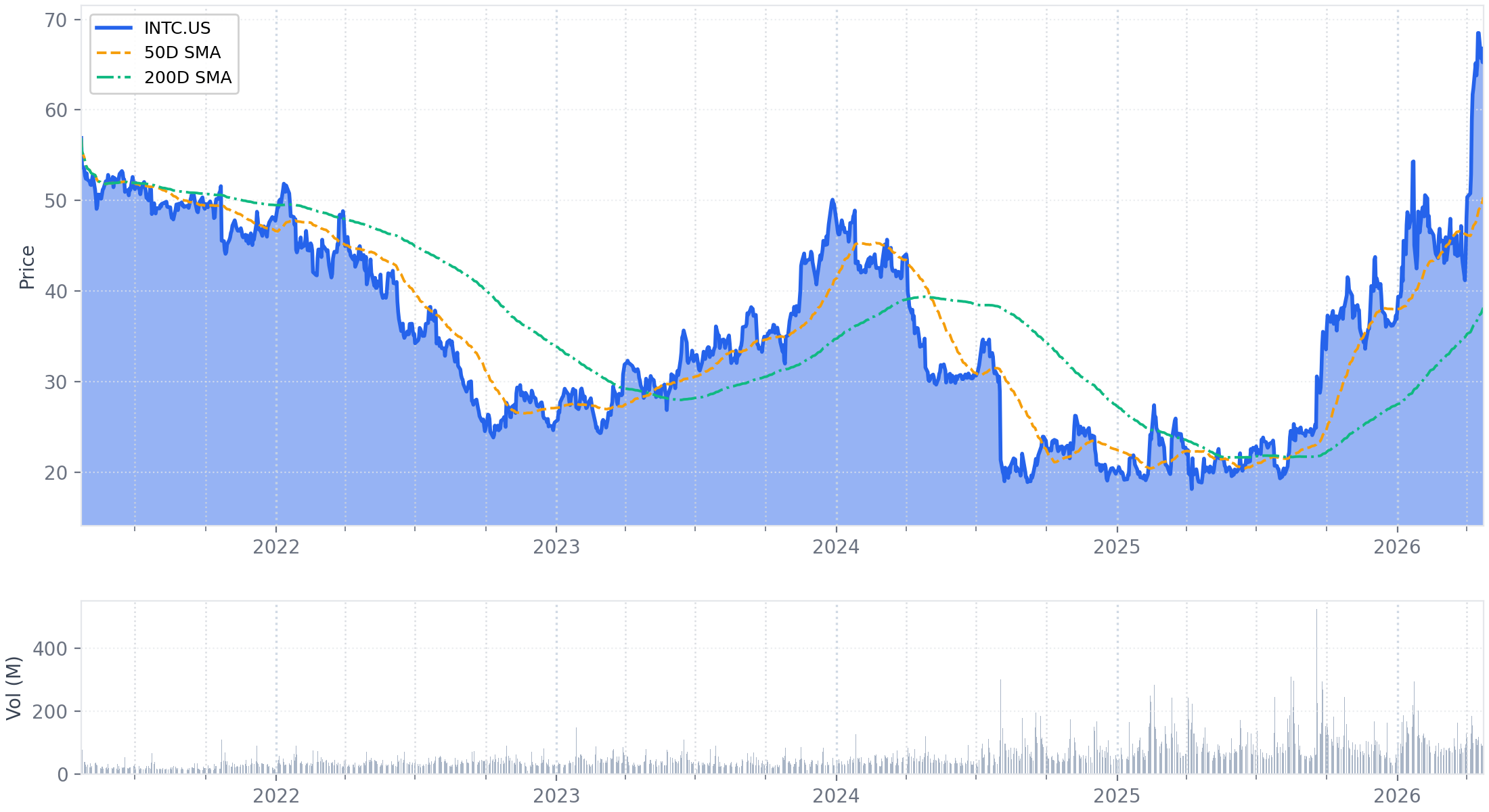
Executive Summary
Intel reported Q1 results that significantly exceeded guidance, with revenue of $13.6 billion and non-GAAP EPS of $0.29, well above the breakeven forecast. The performance was propelled by robust demand for server CPUs, as the Data Center and AI (DCAI) segment grew 22.4% year-over-year. Management highlighted a strategic inflection, stating the CPU is re-establishing its role as the "indispensable foundation" for AI inference and agentic workloads, supporting an improved full-year server TAM outlook of double-digit unit growth.
Despite the strong results, the company continues to face significant supply constraints, with unfulfilled demand estimated in the billions of dollars. Intel guided Q2 revenue to a midpoint of $14.3 billion, implying continued sequential growth. However, non-GAAP gross margin is expected to decline from 41.0% in Q1 to 39.0% in Q2, primarily due to a significant volume ramp of new, initially dilutive Intel 18A products. The quarter marks a shift where strong execution in the high-value server market, bolstered by new strategic partnerships, is offsetting a newly weakened PC market forecast.
1. Financial Performance Summary
A. Income Statement Metrics
Intel reported Q1 revenue of $13.6 billion and non-GAAP EPS of $0.29, with all key metrics exceeding the high end of its prior guidance. Management attributed the outperformance to strong demand, disciplined execution to expand supply, and benefits from improved product mix and pricing actions. The company noted that demand continues to outpace supply across all businesses.
| Metric | Q1 2026 | Q1 2025 | Change | Notes |
|---|---|---|---|---|
| Revenue | $13.6B | $12.7B | ↑ 7.2% | Beat guidance of $11.7B–$12.7B (from Q4'25 transcript). Revenue would have been "meaningfully higher" if not for supply constraints. |
| Total Intel Products | $12.8B | $11.8B | ↑ 8.5% | — |
| Client Computing Group (CCG) | $7.7B | $7.6B | ↑ 1.3% | Better than expectations despite demand outstripping supply. |
| Data Center and AI (DCAI) | $5.1B | $4.1B | ↑ 22.4% | Well above expectations; strength across all segments and customers. |
| Intel Foundry | $5.4B | $4.7B | ↑ 16.2% | Growth driven by increased EUV wafer mix from Intel 3 and significant growth in 18A. |
| All Other | $0.6B | $0.9B | ↓ 33.5% | — |
| GAAP Gross Margin | 39.4% | 36.9% | ↑ 2.5 ppts | — |
| Non-GAAP Gross Margin | 41.0% | 39.2% | ↑ 1.8 ppts | Beat guidance of ~34.5%. Outperformance driven by higher volume, sales of previously reserved inventory, favorable mix, and pricing. |
| GAAP Operating Income (Loss) | ($3.1B) | ($0.3B) | n/m | GAAP operating margin was (23.1)%. |
| CCG Operating Income | $2.5B | $2.4B | ↑ 6.6% | Operating margin of 32.6%. |
| DCAI Operating Income | $1.5B | $0.6B | ↑ 168.2% | Operating margin of 30.5%. |
| Intel Foundry Operating Loss | ($2.4B) | ($2.3B) | n/m | Operating margin of (44.9)%. Loss improved sequentially due to better yields, partially offset by increased investment in Intel 14A. |
| Non-GAAP Operating Income[1] | $1.7B | $0.7B | ↑ 141.7% | Non-GAAP operating margin was 12.3%, up 6.9 ppts YoY. |
| GAAP Net Income (Loss) | ($3.7B) | ($0.8B) | n/m | GAAP net margin was (27.5)%. |
| Non-GAAP Net Income | $1.5B | $0.6B | ↑ 156.0% | Non-GAAP net margin was 11.0%. |
| GAAP EPS (Diluted) | ($0.73) | ($0.19) | n/m | — |
| Non-GAAP EPS (Diluted)[2] | $0.29 | $0.13 | ↑ 123.1% | Beat guidance of $0.00. Includes an approximate $0.06 one-time gain in interest and other. |
Footnotes
- Non-GAAP Operating Income of $1.7B excludes restructuring and other charges ($4.1B), share-based compensation ($0.6B), and acquisition-related adjustments ($0.1B). Total adjustments of $4.8B represent a material variance from the GAAP operating loss of ($3.1B).
- Non-GAAP EPS of $0.29 excludes adjustments totaling $1.02 per share, primarily related to restructuring charges ($0.80), mark-to-market losses on Escrowed Shares ($0.21), and share-based compensation ($0.12), partially offset by adjustments for non-controlling interests (-$0.17).
B. Balance Sheet Highlights
Intel's cash and short-term investments position decreased sequentially to $32.8 billion, partly due to the repurchase of the 49% equity interest in its Fab 34 joint venture, which was funded with approximately $7.7 billion in cash and $6.5 billion in new debt. The company remains committed to deleveraging, planning to retire all $2.5 billion of debt maturities due in 2026.
| Metric | Mar 28, 2026 | Dec 27, 2025 | Change | Notes |
|---|---|---|---|---|
| Cash & Short-Term Investments[1] | $32.8B | $37.4B | ↓ 12.4% | Cash used to fund repurchase of Fab 34 equity interest. |
| Total Debt[2] | $45.0B | $46.6B | ↓ 3.3% | — |
| Short-Term Debt | $2.0B | $2.5B | ↓ 19.8% | — |
| Long-Term Debt | $43.0B | $44.1B | ↓ 2.4% | — |
| Net Debt[3] | $12.2B | $9.2B | ↑ 33.5% | Increase driven by lower cash balance following Fab 34 transaction. |
| Accounts Receivable, net | $4.1B | $3.8B | ↑ 6.0% | — |
| Inventories | $12.4B | $11.6B | ↑ 7.0% | — |
| Accounts Payable | $7.2B | $9.9B | ↓ 27.6% | — |
| Total Intel Stockholders' Equity | $111.4B | $114.3B | ↓ 2.5% | — |
Footnotes
- Total Cash & Short-Term Investments is the sum of Cash and cash equivalents ($17,247M) and Short-term investments ($15,542M).
- Total Debt is the sum of Short-term debt ($2,004M) and Debt ($43,027M).
- Net Debt is calculated as Total Debt ($45,031M) less Total Cash & Short-Term Investments ($32,789M).
C. Cash Flow Analysis
Intel generated $1.1 billion in operating cash flow during the first quarter. Adjusted free cash flow was negative, reflecting gross capital expenditures of $5.0 billion to support increased capacity for committed demand. Excluding the Fab 34 buyout, management reaffirmed its expectation for positive adjusted free cash flow for the full year 2026.
| Metric | Q1 2026 | Q1 2025 | Change | Notes |
|---|---|---|---|---|
| Operating Cash Flow | $1.1B | $0.8B | ↑ 34.8% | — |
| Gross Capital Expenditures | ($5.0B) | ($6.2B) | ↓ 19.9% | — |
| Free Cash Flow (GAAP)[1] | ($3.9B) | ($5.4B) | n/m | — |
| Adjusted Free Cash Flow[2] | ($2.0B) | ($3.7B) | n/m | Management definition adjusts for government incentives and partner contributions. |
Footnotes
- Free Cash Flow (GAAP) is calculated as Operating Cash Flow ($1,096M) less Gross Capital Expenditures ($4,963M).
- Adjusted Free Cash Flow is a non-GAAP metric provided by the company. Reconciliation from GAAP FCF: GAAP FCF ($3,867M) + Proceeds from capital-related government incentives ($107M) + Net partner contributions ($1,959M) - Payments on finance leases ($215M) = ($2,016M).
D. Operational Metrics
Management highlighted growing momentum in AI, which now represents 60% of total revenue. The server CPU outlook has improved, with the company expecting double-digit unit growth for the industry and for Intel in 2026. Conversely, the full-year PC TAM outlook was lowered to a low double-digit percent decline.
| Metric | Status / Value | Notes |
|---|---|---|
| AI-Driven Businesses | ~60% of Revenue, ↑ 40% YoY | Management noted that its collective businesses driven by AI are seeing significant growth. |
| AI PC Revenue Mix | >60% of Client CPU Mix | AI PC revenue grew 8% sequentially. |
| ASIC Business Growth | ↑ >30% QoQ, Nearly Doubled YoY | Strong growth driven by demand for custom silicon in AI infrastructure. |
| Server CPU TAM Outlook | Up Double-Digit % for FY26 | The outlook for server CPU demand has improved over the last 90 days, with momentum expected to extend into 2027. |
| PC TAM Outlook | Down Low-Double-Digit % for FY26 | The company is prudently planning for PC demand to weaken in the second half of the year, in line with industry peers. |
| Product Ramps | Fastest in 5 years | Intel 3-based Xeon 6 and Intel 18A-based Core Series 3 products are in full volume production ramp. |
| External Foundry Revenue | $174M in Q1 | A metric for the emerging external foundry business. |
| 14A Process Development | Outpacing 18A at similar stage | Yield and performance for the next-generation 14A node are tracking ahead of schedule. Customer design commitments are expected in H2 2026. |
| Advanced Packaging | Growing Customer Backlog | The company noted continued progress and growth in customer backlog for its advanced packaging services. |
2. Forward-Looking Guidance
A. Guidance Summary
Intel provided Q2 2026 guidance that anticipates sequential revenue growth, though gross margins are expected to decline modestly due to the mix shift towards Intel 18A products. For the full year, the company revised its capital expenditure and operating expense outlooks upward, citing increased investment to meet strong demand.
| Metric | Period | Current Guidance | Prior Guidance (from Q4'25 Call) | Change | Management Commentary |
|---|---|---|---|---|---|
| Revenue | Q2 2026 | $13.8B – $14.8B | N/A | Introduced | The midpoint of $14.3B implies sequential growth of 2%–9%, driven by improved supply and pricing actions. |
| Non-GAAP Gross Margin | Q2 2026 | ~39.0% | N/A | Introduced | The modest sequential decline is attributed to a "meaningfully larger contribution from Intel 18A" which is still early in its ramp, and some Q1 inventory benefits not expected to repeat. |
| Non-GAAP EPS | Q2 2026 | ~$0.20 | N/A | Introduced | Based on the midpoint of the revenue range. |
| Operating Expenses (Non-GAAP) | FY 2026 | Likely higher than $16.0B | ~$16.0B | Revised Higher | The increase is due to inflationary pressures, variable compensation, and targeted investments to capture growth opportunities. |
| Gross Capital Expenditures | FY 2026 | Flat YoY | Flat to down slightly YoY | Revised Higher | Reflects increased capacity investments to support committed demand and a continued emphasis on improving fab productivity. Spending is expected to be roughly equal across the year. |
| Adjusted Free Cash Flow | FY 2026 | Positive[1] | Positive | Reaffirmed | Management reaffirmed its expectation for positive adjusted free cash flow for the full year. |
| Non-Controlling Interests (NCI)[2] | FY 2026 | ~$250M in each of Q2, Q3, Q4 | ~$1.2B | Revised | Guidance was updated following the buyout of the Fab 34 joint investment. The prior guidance covered the full year under the previous structure. |
Footnotes
- The positive adjusted FCF outlook now explicitly excludes the impact of the Fab 34 joint investment buyout.
- Guidance is on a GAAP basis.
B. Additional Notes & Commentary
-
Q2 2026 Segment Outlook: Management expects sequential revenue growth in both CCG and DCAI, with DCAI guided to be up double-digits. This is attributed to improved supply and a full quarter of pricing actions.
-
Full-Year 2026 Outlook:
- Revenue Seasonality: Management expects half-on-half revenue to follow historical seasonal trends, with servers performing above and PCs below those trends.
- Supply: Factory output is expected to continue increasing in Q3 and Q4, but at a "more measured pace" than anticipated 90 days ago, reflecting the stronger-than-expected output in the first half.
- Gross Margin Headwinds: Management cautioned that rising input costs, particularly for memory, present growing headwinds in the second half of the year that the company needs to overcome to achieve gross margin expansion.
- PC TAM: The company is planning for the full-year PC unit TAM to be down low double-digit percent, a downward revision reflecting weakening demand expectations for the second half.
- Server CPU TAM: The outlook has improved over the last 90 days. Management expects a strong year of double-digit unit growth for the industry and for Intel, with momentum extending into 2027.
-
Long-Term Foundry Milestones:
- Intel 14A: The company continues to expect initial customer design commitments to emerge in the second half of 2026 and expand into the first half of 2027.
- Advanced Packaging: Committed demand from the growing backlog is expected to begin converting to revenue in 2027.
3. Operational & Strategic Developments
A. Business Performance & Operations
-
Product & Process Milestones:
- Intel achieved a significant operational milestone with Intel 3-based Xeon 6 and Intel 18A-based Core Series 3 products now in a full volume production ramp, which management described as the fastest new product ramp in five years.
- Yields on the critical Intel 18A process are running ahead of internal projections, representing a "meaningful inflection" in execution and factory output. This marks continued progress from Q4, where yields were improving but not yet at an "industry-leading standard."
- The Intel 14A process is also progressing well, with maturity, yield, and performance outpacing Intel 18A at a similar point in its development cycle.
-
Market Position & Competitive Dynamics:
- Management presented a strong case for the CPU’s resurgence in the AI landscape, moving beyond training to inference and agentic workloads. The CEO stated that the CPU is reinserting itself as the "indispensable foundation of the AI era," serving as the orchestration and control plane for the entire AI stack.
- This view is reportedly supported by customer demand, with the ratio of server CPUs to accelerators moving back towards parity (from 1:8 to 1:4 and trending lower). This dynamic is fueling strong and sustained momentum for the Xeon server business.
-
Differences from Expectations:
- Server CPU Outlook (Improved): The outlook for server CPU demand has materially improved over the last 90 days. Management now expects a strong year of double-digit unit growth for the industry and for Intel, with momentum extending into 2027.
- PC TAM Outlook (Worsened): Conversely, the company is now "prudently planning for PC demand to weaken in the second half," forecasting the full-year PC unit TAM to be down low-double-digit percent.
B. Strategic Initiatives
-
Cultural Transformation: Management emphasized a strategic reset back to its roots as a "data-driven, paranoid and engineering-centric company." The narrative has shifted from surviving to scaling supply to meet what management describes as "enormous demand."
-
Partnerships & Long-Term Agreements (LTAs):
- Google: Announced a multi-year LTA for Xeon processors and the co-development of custom ASIC IPUs.
- NVIDIA: Xeon 6 was selected as the host CPU for NVIDIA’s DGX Rubin NVL8 systems, maintaining a critical position in leading AI infrastructure.
- SambaNova Systems: Established a collaboration to design a next-generation heterogeneous AI inference architecture.
- Terafab Project: Joined as a strategic partner with SpaceX, xAI, and Tesla to explore "unconventional ways to improve manufacturing efficiency."
- Management confirmed multiple LTAs were signed in Q1, typically structured with volume and pricing commitments over a 3-to-5-year period.
-
Operational & Capacity Expansion:
- Fab 34 Buyout: Intel repurchased the 49% minority equity interest in its Fab 34 joint investment in Ireland, a strategic move to capture the full economic benefits of the facility.
- Advanced Packaging: The company is expanding its back-end facilities in Malaysia to support a growing customer backlog, with committed demand expected to begin converting to revenue in 2027.
C. Risk Factors & Headwinds
-
Supply Constraints (Persistent): This remains the most significant operational challenge. Management stated that demand continues to run ahead of supply for all its businesses. An analyst noted that even with an unconstrained supply, revenue could have been billions of dollars higher. While factory output is increasing, management cautioned that the pace of supply additions in the second half of 2026 would be "more measured than we anticipated 90 days ago."
-
Rising Input Costs (New & Persistent): Management flagged growing headwinds for the second half of the year from constraints and rising prices for key components like memory, wafers, and substrates.
-
PC Market Weakness (New): The downward revision of the full-year PC TAM forecast to a low-double-digit percent decline represents a significant market headwind for the Client Computing Group (CCG).
4. Q&A Session Key Themes
A. Analyst Focus Areas
-
Server CPU Demand and Competition: Analysts sought to quantify the "double-digit" server TAM growth and understand the impact of new "agentic" AI workloads. Management explained that the CPU's role as the "orchestration layer" in the AI stack is becoming more critical, leading to an improving ratio of CPUs to accelerators. On competition against both x86 and Arm-based rivals, management expressed confidence in its roadmap and its ability to serve customers through foundry and advanced packaging services.
-
Foundry Strategy & Execution: The newly announced Terafab partnership prompted questions about new business models. The CEO framed it as an innovative collaboration to address global supply-demand imbalances. Management reiterated that it expects firm design commitments for Intel 14A to emerge in H2 2026 and expand into H1 2027, which will then trigger capital investments. The advanced packaging opportunity was again highlighted as a significant growth driver, with customer demand at a "billions of dollars per year kind of level."
-
Gross Margin Headwinds: Analysts questioned why Q2 gross margin guidance was not stronger, given the tailwind from high-margin server products. Management identified the Intel 18A ramp as the primary headwind. The CFO explained that while yields are improving, the volume of Panther Lake products is expected to increase by "6 or 7x" in Q2 relative to Q1. As the margins for this new process are still below the corporate average, this significant mix shift weighs on overall gross margin.
-
Supply Constraints & Missed Revenue: In a notable exchange, the CFO stated that the amount of unfulfilled demand "starts with a B," confirming that the company is missing out on billions of dollars in potential revenue. Management outlined its plan to increase output through improved yields and a significant increase in manufacturing tool spend, projected to be up approximately 25% year-over-year.
B. Key Challenges & Concerns
-
Reconciling Strong Server Growth with Margin Dilution: The primary analytical challenge was reconciling the strong, high-margin DCAI growth with a gross margin forecast that was only flat to slightly down from Q1’s adjusted level. The management’s explanation regarding the dilutive impact of the aggressive Intel 18A ramp was critical in clarifying this dynamic.
-
Viability of Server Competitiveness: Analysts challenged management on how Intel would compete against a proliferating number of custom Arm-based CPUs from major hyperscalers. Management’s response was multi-faceted, pointing to their refined product roadmap (Granite/Diamond/Coral Rapids), the deep integration of the x86 ecosystem, and the strategic advantage of offering a full stack of solutions.
5. Strategic Themes & Inflection Points
A. Current Period Themes
-
From Survival to Scaling: The most pronounced change from the prior quarter was the shift in management’s tone. The CEO directly contrasted the conversation a year ago about "whether we could survive" with today’s focus on "how quickly we can add manufacturing capacity." This replaces the "hand to mouth" supply narrative of Q4 with a more assertive posture centered on meeting "enormous demand."
-
The CPU's Resurgence in the AI Era: Management is building its strategy around the premise that as AI moves from training to inference and agentic workloads, the CPU’s importance grows. This is positioned as a structural tailwind for the x86 franchise, supported by an improving ratio of CPUs to accelerators in AI deployments (from 1:8 toward 1:4 or better).
-
Strategic Partnerships as Validation: This quarter was defined by high-profile external collaborations (Google, NVIDIA, Terafab) and multiple long-term agreements. These are being used to validate the company's technology roadmap and secure a long-term demand profile, providing greater confidence for future capacity investments.
B. Future Considerations
-
Multi-Pillar Growth Beyond the CPU: The long-term strategy is becoming more defined across three distinct but interconnected pillars:
- Core CPU Dominance: Capitalizing on the AI-driven server refresh cycle.
- ASIC & Custom Silicon: Growing the "purpose-built" silicon business, which is already at a run rate north of $1 billion.
- Comprehensive Foundry Services: Building an offering that extends beyond wafers to include differentiated, high-value advanced packaging—now seen as a "billions of dollars per year" opportunity.
-
Bifurcation of End Markets: The company’s future performance is increasingly tied to the data center and AI markets. The improved server CPU TAM outlook (up double-digits) stands in sharp contrast to a newly weakened PC TAM forecast (down low-double-digits), highlighting the need for flawless execution in the DCAI segment.
-
The Long Road to Margin Recovery (Reaffirmed): Despite strong revenue performance, gross margin recovery remains a multi-quarter journey. Management was clear that the aggressive ramp of the new, initially dilutive Intel 18A process, combined with rising input costs, will continue to be near-term headwinds.
6. Key Items to Monitor Next Quarter
A. Prior Quarter Monitoring Review
The following table provides an update on the key items identified for monitoring in the prior quarter's analysis (Q4 2025).
| Prior Item | Current Status | Management Commentary |
|---|---|---|
| Internal Supply Constraint Resolution | On Track | The supply-demand imbalance persists, with management stating that demand continues to run ahead of supply for all businesses. However, progress is being made on increasing factory output, and the narrative has shifted from being "hand to mouth" to scaling capacity to meet "enormous demand." |
| Intel 14A External Foundry Customer Commitments | On Track | The timeline for securing external customer commitments remains unchanged, with management expecting firm design wins to emerge in H2 2026 and expand into H1 2027. |
| Gross Margin Recovery Path | Ahead of Schedule | The company significantly exceeded expectations, delivering a non-GAAP gross margin of 41.0% in Q1, well above the prior guidance of ~34.5% and the 40% recovery target mentioned in the previous report. The Q2 guide of ~39.0% remains strong. |
| Advanced Packaging Customer Wins | On Track | Management reported "additional growth in customer backlog" for advanced packaging services during the quarter. The company is investing in a multiyear expansion of its Malaysian facility to support committed demand. |
| Server Roadmap Execution (Coral Rapids) | On Track | Management reiterated its commitment to accelerating the introduction of Coral Rapids, which will reintroduce multi-threading to compete more effectively. No specific timeline updates were provided. |
B. Current Quarter Focus Items
The following table outlines the most critical non-guidance metrics and developments to monitor.
| Category | Item | Timeline | What to Monitor | Why It Matters |
|---|---|---|---|---|
| Risk / Operational | Execution in Diverging End Markets | FY 2026 | The ability to deliver strong double-digit growth in the DCAI segment to offset the newly forecast low-double-digit percent decline in the full-year PC TAM. | The company’s overall financial performance for 2026 is now heavily dependent on capitalizing on the robust server market to counteract significant headwinds in its large client business. |
| Strategic / Opportunity | "Agentic AI" CPU Demand & Attach Rates | Ongoing | Tangible evidence that the shift to inference and agentic AI is driving a structural increase in server CPU demand. Key indicators include the CPU-to-accelerator attach ratio continuing to improve toward parity. | This trend is the foundation of the company’s improved server outlook. Validating this dynamic is critical to the thesis that Intel’s core x86 franchise is a primary beneficiary of the next wave of AI. |
| Risk | Gross Margin Sustainability vs. Headwinds | H2 2026 | The ability to defend gross margins near the ~39-41% level against headwinds from the aggressive Intel 18A ramp and rising input costs for memory and substrates. | Sustaining margins near 40% is crucial for profitability and demonstrating that operational improvements can outweigh the dilutive effects of new nodes and cost inflation. |
| Strategic | Securing Intel 14A External Customer Commitments | H2 2026 – H1 2027 | The emergence of the first firm design commitments from external customers for the Intel 14A process. | This remains the single most important external validation point for the entire foundry strategy, de-risking future CapEx and signaling market confidence in the long-term technology roadmap. |
| Opportunity | Execution on High-Profile Strategic Partnerships | Ongoing | Concrete updates or milestones from the newly announced partnerships, particularly the Terafab project with SpaceX, xAI, and Tesla. | These high-profile partnerships signal a strategic shift toward external validation and collaboration. Tangible progress would demonstrate that Intel can leverage its unique assets in innovative ways to create new value. |
Appendix: Quotes by Theme
-
Strategic Narrative Shift: From Survival to Scaling to Meet "Enormous Demand": Management explicitly reframed the company's position, marking a significant evolution from a defensive posture in prior quarters to an offensive one focused on scaling to capture a structural demand shift.
"A year ago, the conversation about Intel was about whether we could survive. Today, it's about how quickly we can add manufacturing capacity and scale our supply to meet enormous demand for our products. This is a fundamentally different company today, and we still have a lot of work ahead." — Lip-Bu Tan, CEO
- vs Q4-FY25:
"In the short term, I'm disappointed that we are not able to fully meet the demand in our markets... our buffer inventory is depleted... our internal supply constraints are most acute in Q1." — David Zinsner, CFO
-
The Resurgence of the CPU as the Foundation of the AI Era: The central theme of the call was management's conviction that the CPU's role is becoming more critical as AI workloads shift from training to inference and agentic applications, creating a structural tailwind for the core business.
"In recent months, we have seen clear signs that the CPU is reinserting itself as the indispensable foundation of the AI era. CPU now serves as the orchestration layer and critical control plane for the entire AI stack. This is not just our wishful thinking, it is what we hear from our customers, and it is evident in the demand profile for our products." — Lip-Bu Tan, CEO
"If you look at training solutions, they're generally running in the kind of 7 to 8 GPUs to 1 CPU. As we look into inference, it's probably getting into like the 3 to 4:1 kind of level. And as you get into agentic and multi-agent, it's one potentially even flip in the other direction a little bit." — David Zinsner, CFO (Q&A)
-
Quantifying the Scale of Unfulfilled Demand: In response to analyst questions, management provided a stark quantification of the revenue opportunity being missed due to ongoing supply constraints, highlighting the urgency of scaling production.
Analyst: "Is there a way to sort of quantify like how much demand you're sort of missing out on? Like how much are you undershipping the market still in Q2?"
"I probably not want to put a specific number. Let's just say it starts with a B. So it's meaningful." — David Zinsner, CFO (Q&A)
-
Gross Margin Headwinds from the Intel 18A Ramp: Analysts questioned the muted Q2 gross margin guide despite strong server growth. Management explained the dilutive near-term impact is due to a massive volume increase of the new, not-yet-optimized Intel 18A process.
"18A is going to be a pretty decent headwind to our gross margins. And if you look at Panther Lake volume increases, it's going to be going up, I don't know, 6 or 7x in the second quarter relative to the first quarter. And while the gross margins are improving... it's still below the corporate average. So when you have that big a shift in the mix... it kind of weighs down on the gross margins." — David Zinsner, CFO (Q&A)
- vs Q4-FY25 (less specific commentary):
"Gross margin is down sequentially due to lower revenue, increased 18A volumes and product mix." — David Zinsner, CFO
-
Diverging End Market Outlooks: Management articulated a clear bifurcation in its market outlook, with strong conviction in the server market's growth trajectory contrasting sharply with a newly cautious forecast for the PC market.
"Our outlook for server CPU demand has improved over the last 90 days, and we expect a strong year of double-digit unit growth... with momentum extending into 2027... Offsetting this, we're prudently planning for PC demand to weaken in the second half of the year and expect the full year PC unit TAM to be down low double-digit percent." — David Zinsner, CFO
-
Foundry Opportunity in Advanced Packaging: Management reiterated its confidence in the advanced packaging business, framing the opportunity as a multi-billion dollar driver for the foundry segment, consistent with messaging from the prior quarter.
"I had thought that these opportunities would come in the hundreds of millions of dollars level. But so far, what we're seeing is that their demand is more in the billions of dollars per year kind of level. So this is going to be a big part of the foundry revenue as we get through this decade." — David Zinsner, CFO (Q&A)
- vs Q4-FY25:
"I'd say some of the early customer engagements suggest that we'll be well north of $1 billion on many of these opportunities for advanced packaging. So they're way more exciting than even I had expected." — David Zinsner, CFO (Q&A)
-
Long-Term Agreements Signal Growing Business Predictability: Management highlighted the signing of multiple long-term agreements (LTAs), including with Google, as evidence of deepening customer partnerships and a key mechanism for improving long-term supply and demand visibility.
"Most of these agreements are structured with volume and pricing, and they are usually somewhere between 3 and 5 years... It's a win-win, I think, in a lot of ways. We get a good understanding of the volumes that we can then build into our assumptions around supply." — David Zinsner, CFO (Q&A)
-
Addressing Server Competition from Arm-based CPUs: When challenged by analysts on the growing competition from Arm-based server CPUs (NVIDIA Vera, Google Axion, Amazon Graviton), management emphasized its multi-faceted competitive strategy, which extends beyond the CPU product itself.
"We have another bite at the apple or maybe multiple bites at the apple on the foundry side. We can provide customers with advanced packaging. We can provide customers with wafers. So we have a pretty strong breadth of offerings to customers to help support their CPU needs or AI needs in the marketplace." — David Zinsner, CFO (Q&A)
-
Execution Focus on Closing Competitive Gaps: Management reinforced its commitment to executing on a server roadmap designed to close key competitive gaps, specifically highlighting the reintroduction of multithreading.
"We are laser-focused on execution. Multithreading, I think we are putting in. So we're going to have Coral Rapid, have the multithreading that we can compete effectively with AMD. And we try to accelerate that Coral Rapid ahead." — Lip-Bu Tan, CEO (Q&A)
- vs Q4-FY25:
"With Coral Rapids, we will also reintroduce multi-threading back into our data center road map." — Lip-Bu Tan, CEO
Historical Performance