Executive Summary
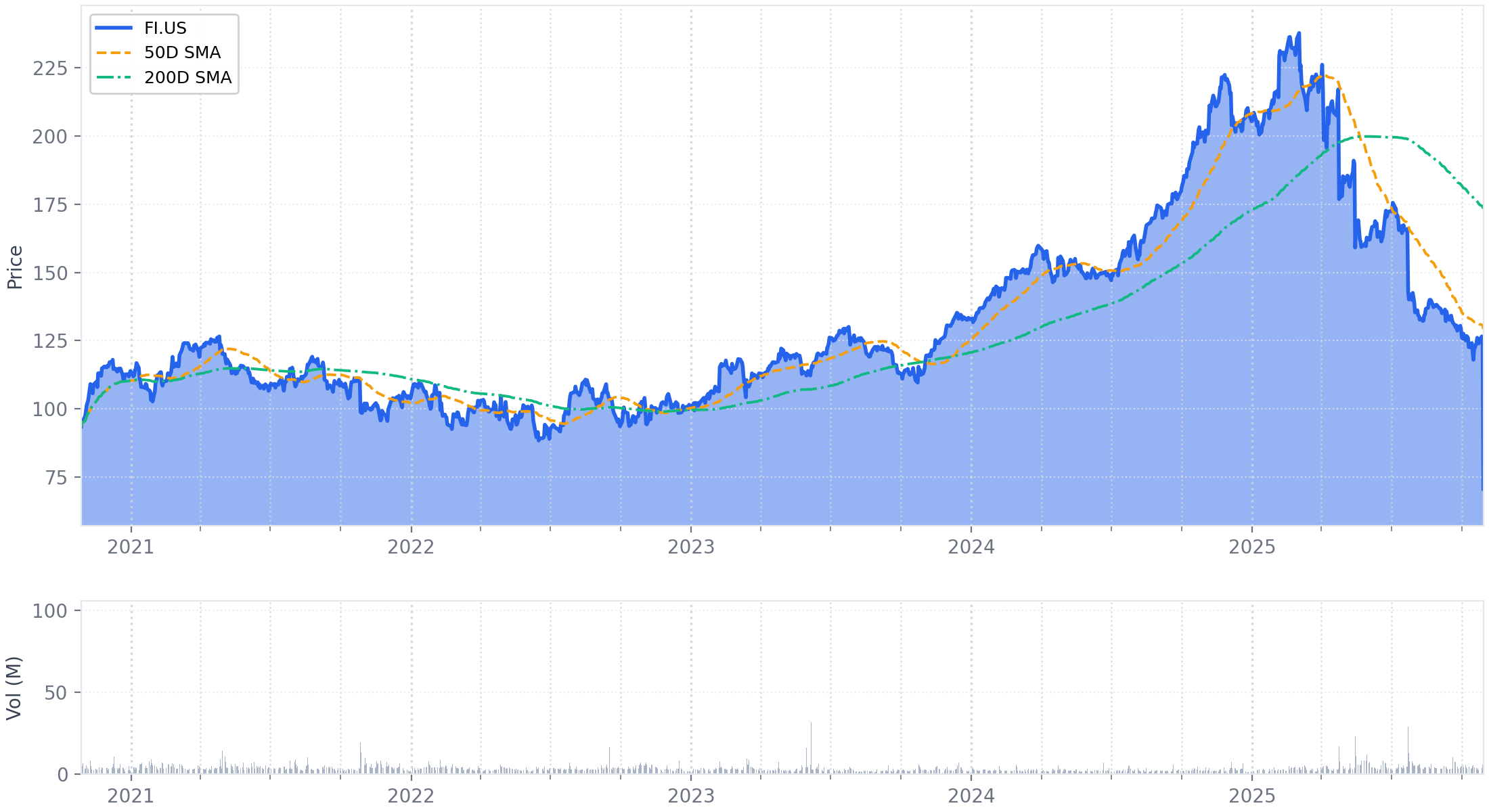
Fiserv announced a critical and necessary reset after Q3 results revealed a significant performance shortfall, with organic revenue growth of just 1% and an 11% decline in adjusted EPS to $2.04. Consequently, the company dramatically lowered its full-year 2025 guidance, cutting its organic revenue growth outlook from ~10% to 3.5%-4.0% and its adjusted EPS forecast from a midpoint of ~$10.23 to $8.55.
Management attributed the reset to a rigorous internal analysis that uncovered systemic issues, including the impact of past underinvestment, an over-reliance on unsustainable short-term initiatives, flawed original guidance assumptions, and a cyclical slowdown in Argentina. In response, the company launched a new "One Fiserv" action plan and announced a sweeping overhaul of its leadership team and board, including a new CFO, two Co-Presidents, and a new Independent Chairman.
The preliminary outlook for 2026 is for a transition year, with low single-digit revenue growth and modestly declining EPS. The company has reset its long-term growth algorithm, now targeting a return to double-digit adjusted EPS growth starting in 2027, reframing the investment case from near-term execution to a multi-year turnaround story contingent on the new management team’s ability to restore operational credibility.
1. Financial Performance Summary
Fiserv's third-quarter results marked a significant reset, with performance falling well short of the trajectory implied by prior guidance. The company reported 1% organic revenue growth and an 11% decline in adjusted EPS to $2.04. This performance prompted a comprehensive downward revision of full-year 2025 guidance and the introduction of a new "One Fiserv" action plan aimed at establishing a new operational and financial baseline for the company.
A. Income Statement Metrics
The quarter was characterized by a sharp deceleration in growth and profitability. Total company adjusted operating margin contracted by 320 basis points to 37.0%. The Financial Solutions segment saw a notable 3% organic revenue decline and a 490 basis point margin contraction. The Merchant Solutions segment posted 5% organic growth, but its margin also declined by 50 basis points.
| Metric (in millions) | Q3 2025 | Q3 2024 | Change (%) | Notes |
|---|---|---|---|---|
| Total Company | ||||
| GAAP Revenue | $5,263 | $5,215 | 0.9% ↑ | — |
| Adjusted Revenue | $4,919 | $4,884 | 0.7% ↑ | Total company organic revenue growth was 1%. |
| Adjusted Operating Income | $1,822 | $1,962 | -7.1% ↓ | Includes an $89M gain from the termination of a merchant alliance JV. |
| Adjusted Operating Margin | 37.0% | 40.2% | -320 bps ↓ | Impacted by lower high-margin revenue and increased investments. |
| GAAP EPS | $1.46 | $0.98 | 49.0% ↑ | Prior year included a $570M non-cash impairment charge. |
| Adjusted EPS | $2.04 | $2.30 | -11.3% ↓ | Includes a $0.10 headwind from FX, a $0.04 headwind from Argentina interest expense, and a $0.16 tailwind from a JV termination gain. |
| Segment Performance | ||||
| Merchant Solutions | ||||
| Revenue[1] | $2,586 | $2,469 | 4.7% ↑ | Organic revenue growth was 5%. |
| Operating Income[1] | $962 | $931 | 3.3% ↑ | Includes the $89M JV termination gain. |
| Operating Margin[1] | 37.2% | 37.7% | -50 bps ↓ | Margin detraction from higher sales, marketing, and data processing costs was partially offset by the JV gain. |
| Financial Solutions | ||||
| Revenue[1] | $2,333 | $2,412 | -3.3% ↓ | Organic revenue declined 3%, with performance impacted by lower periodic license revenue. |
| Operating Income[1] | $991 | $1,143 | -13.3% ↓ | — |
| Operating Margin[1] | 42.5% | 47.4% | -490 bps ↓ | Margin decline driven by lower high-margin license revenue and ongoing technology and implementation investments. |
Footnotes
- Per the 8-K filing, for the Merchant and Financial segments, there were no adjustments to GAAP measures; thus, the adjusted measures are equal to the GAAP measures presented.
B. Balance Sheet Highlights
Total debt increased significantly from year-end, primarily to fund share repurchases. The company's leverage ratio rose to the top end of its target range.
| Metric (in millions) | Sep 30, 2025 | Dec 31, 2024 | Change (%) | Notes |
|---|---|---|---|---|
| Cash and Cash Equivalents | $1,068 | $1,236 | -13.6% ↓ | — |
| Total Debt[1] | $30,199 | $24,840 | 21.6% ↑ | Debt increased to fund capital returns and acquisitions. |
| Net Debt[2] | $29,131 | $23,604 | 23.4% ↑ | The debt-to-adjusted EBITDA ratio increased slightly to 3.0x, at the top of the company's 2.5x to 3.0x target range. |
| Total Fiserv Shareholders' Equity | $25,121 | $27,068 | -7.2% ↓ | Decline reflects significant share repurchase activity. |
Footnotes
- Total Debt is calculated as Short-term and current maturities of long-term debt + Long-term debt. For Sep 30, 2025: $1,323M + $28,876M = $30,199M. For Dec 31, 2024: $1,110M + $23,730M = $24,840M.
- Net Debt is calculated as Total Debt - Cash and Cash Equivalents. For Sep 30, 2025: $30,199M - $1,068M = $29,131M. For Dec 31, 2024: $24,840M - $1,236M = $23,604M.
C. Cash Flow Analysis
Year-to-date free cash flow declined compared to the prior year, influenced by lower net income (on an adjusted basis) and higher capital expenditures. Share repurchases remained a primary use of cash.
| Metric (YTD) (in millions) | Nine Months Ended Sep 30, 2025 | Nine Months Ended Sep 30, 2024 | Change (%) | Notes |
|---|---|---|---|---|
| Net Cash from Operating Activities | $4,118 | $4,410 | -6.6% ↓ | — |
| Capital Expenditures | ($1,321) | ($1,170) | 12.9% ↑ | CapEx is now expected to be ~$1.8B for the full year (~9% of revenue), higher than previous expectations due to the 'One Fiserv' initiative. |
| Free Cash Flow (per filing) | $2,879 | $3,344 | -13.9% ↓ | Full-year FCF guidance was lowered to ~$4.25B due to the revised earnings outlook and higher CapEx. |
| Share Repurchases | ($5,400) | ($4,491) | 20.2% ↑ | Repurchased 7.2 million shares for $1.0 billion in Q3. YTD, the company has repurchased 29.1 million shares. |
| Net Debt Issuance[1] | $3,570 | $1,821 | 96.0% ↑ | The company was a net issuer of debt to fund operations and capital returns. |
Footnotes
- Net Debt Issuance is calculated from the financing section of the cash flow statement. For 2025: Debt proceeds ($5,753M) + Net borrowings from commercial paper ($1,169M) - Debt repayments ($3,352M) = $3,570M. For 2024: Debt proceeds ($6,141M) + Net borrowings from commercial paper ($345M) - Debt repayments ($4,665M) = $1,821M.
D. Operational Metrics
Clover remained a key growth driver, though its full-year revenue outlook was trimmed. Management noted that underlying volume growth was roughly in line with expectations after adjusting for currency fluctuations and higher-than-expected runoff from a gateway conversion.
| Metric | Q3 2025 | Notes |
|---|---|---|
| Clover Performance | ||
| Revenue Growth | 26% | — |
| GPV Growth (Reported) | 8% | Impacted by FX headwinds from the Argentine peso. Adjusted for FX, reported GPV growth was 9%. |
| GPV Growth (Ex-Gateway Conversion) | 11% | Management noted this was similar to Q2 growth. Adjusted for FX, growth was 12%, which was in line with expectations. |
| SaaS Penetration | 26% | Driven by strength in vertical software sales, Clover Capital, and anticipation revenue. |
| Merchant Segment Metrics | ||
| Small Business Volume Growth | 8% | — |
| Enterprise Transaction Growth | 12% | — |
| Financial Segment Metrics | ||
| Key Transaction Growth | "Healthy" | Management noted healthy growth in debit processing, debit network, and Zelle transactions but did not provide specific figures. |
2. Forward-Looking Guidance
Fiserv issued a significant downward revision to its full-year 2025 guidance and provided a preliminary outlook for 2026, which it described as a "critical investment and transition year." The company has reset its financial baseline to reflect a more challenging operating environment, the impact of necessary investments, and a strategic shift away from short-term initiatives.
A. Guidance Summary
| Metric | Period | Current Guidance | Prior Guidance | Change | Management Commentary |
|---|---|---|---|---|---|
| Organic Revenue Growth | FY 2025 | 3.5% to 4.0% | ~10% | Lowered | The revision reflects current conditions in Argentina, recalibration of prior assumptions, necessary investments, and the deprioritization of short-term initiatives. |
| Adjusted EPS | FY 2025 | $8.50 to $8.60 | $10.15 to $10.30 | Lowered | Represents a modest year-over-year decline. The reduction is driven by the lower revenue outlook and increased investment spending. |
| Free Cash Flow | FY 2025 | ~$4.25 billion | ~$5.5 billion | Lowered | The decrease is a direct result of the revised earnings outlook and a higher level of planned capital expenditures. |
| Capital Expenditures | FY 2025 | ~$1.8 billion | Not explicitly provided | New/Revised Upward | The higher level of CapEx (~9% of revenue) is directly tied to the start of the "One Fiserv" initiative. |
| Clover Revenue | FY 2025 | $3.3 billion | $3.5 billion | Lowered | The reduction reflects the deprioritization of certain short-term revenue initiatives, including the elimination of certain fees in Q4. |
| Clover Revenue Growth | Q4 2025 | ~10% | Not provided | New | Growth is expected to be below recent levels. Adjusting for the elimination of certain fees, management stated growth would be in the high teens. |
| Organic Revenue Growth | FY 2026 (Preliminary) | Low single-digits | Not provided | New | Management describes 2026 as a critical investment and transition year that will mark the new baseline for future growth. |
| Adjusted EPS | FY 2026 (Preliminary) | Down modestly vs. 2025 | Not provided | New | Reflects the full-year impact of strategic investments being made as part of the "One Fiserv" action plan. |
| Revenue Growth | Post-2026 | Mid-single-digits, with potential for acceleration | Not provided | New | Positioned to return to Fiserv's historical growth profile after the 2026 transition year. |
| Adjusted EPS Growth | Post-2026 | Double-digits, starting in 2027 | 15% to 17% (Medium-Term Outlook from FY24) | Reset | Aims to re-establish a "durable compounder value proposition" based on operating leverage and disciplined capital allocation. |
B. Additional Notes & Commentary
- Investor Day: Management announced plans to host an Investor Day in the first half of 2026 to provide more details on the "One Fiserv" action plan and a new medium-term outlook.
- Forecasting Philosophy: The company signaled a change in its approach to guidance, committing to "more clearly explain our growth drivers, enhance the rigor in our forecasting, which will allow us to provide high conviction guidance."
3. Operational & Strategic Developments
The third quarter marked a pivotal reset for Fiserv, defined by the formal acknowledgment of deep-seated operational issues and the launch of a comprehensive turnaround strategy named the "One Fiserv" action plan. Management's commentary shifted from explaining execution delays in the prior quarter to a more fundamental recalibration of the company's growth potential, investment needs, and leadership structure.
A. Business Performance & Operations
- Clover Strategic Shift: The platform's near-term outlook was impacted by a strategic decision to deprioritize short-term initiatives, including the elimination of certain fees. Management noted that underlying GPV growth was roughly in line with their expectations after adjusting for a significant negative FX impact from the Argentine peso.
- Segment Performance Breakdown:
- Merchant Solutions: The Small Business unit grew 6% organically, while Enterprise grew 9%. The Enterprise segment continues to face a "grow-over challenge" from network fees associated with a large PFAC client that will persist through H1 2026. Processing organic revenue declined 8% due to difficult prior-year comparisons.
- Financial Solutions: The segment experienced a broad-based organic revenue decline of 3%.
- Digital Payments revenue declined 5% due to unspecified "industry dynamics."
- Issuing revenue grew a modest 1%, muted by grow-over challenges in the output business.
- Banking revenue declined 7%, primarily due to lower periodic license activity, a high-margin item.
B. Strategic Initiatives
The company announced a major strategic overhaul centered on the "One Fiserv" action plan and a new AI-powered transformation program.
- "One Fiserv" Action Plan: This new plan is designed to refocus the company on five strategic pillars:
- Client-First Mindset: Win new enterprise clients and grow Average Revenue Per Client (ARPC) by expanding sales, relationship management, and service staff.
- Clover as Preeminent SMB Platform: Continue investing to build Clover into a full small business operating system.
- Differentiated Platforms: Invest in modernizing platforms, including streamlining banking cores from 16 to 5, building out merchant orchestration layers (Commerce Hub), and expanding stablecoin capabilities (FIUSD).
- AI-Enabled Operational Excellence: Launch of Project Elevate, a multi-year transformation program in partnership with IBM, to embed AI across key processes like sales, client onboarding, and Clover client service.
- Disciplined Capital Allocation: An ongoing review with McKinsey to optimize the business mix, which includes plans to monetize certain smaller, non-critical businesses.
- New Partnerships and Wins: Despite the internal reset, the company highlighted several new business wins, including an exclusive long-term partnership with Nubank, the company's largest-ever healthcare deal, and a partnership to bring the Clover solution to Japan.
C. Risk Factors & Headwinds
The quarter’s results and commentary revealed several significant financial and operational challenges that prompted the strategic reset.
- Guidance Reliability Collapse: The company dramatically lowered its full-year 2025 guidance across all key metrics just one quarter after refining it, signaling a significant breakdown in its forecasting process.
- Admission of Systemic Issues: Management's explanation for the reset moved beyond "delayed initiatives" to more fundamental, systemic problems including:
- Past Underinvestment: Management admitted that prior decisions to "defer certain investments and cut certain costs" improved short-term margins but are now "limiting our ability to serve clients in a world-class way."
- Over-reliance on Short-Term Initiatives: The company’s recent results had "increasingly relied on short-term initiatives" that are not sustainable and are now being deprioritized.
- Flawed Original Guidance: It was revealed that the original 2025 guidance embedded "objectively difficult to achieve" assumptions.
- Argentina Exposure Unmasked: The cyclical slowdown in Argentina is now a significant headwind. Management provided new transparency, showing that Argentina contributed over 5 percentage points to 2023 organic growth and roughly 10 percentage points to 2024 organic growth. Excluding Argentina, underlying company growth was in the mid-single-digits in both years.
D. Management and Board Overhaul
Fiserv announced a sweeping overhaul of its senior leadership team and board of directors, signaling a clear break from the prior operational regime.
- Executive Leadership Overhaul:
- Co-Presidents (New Roles): Takis Georgakopoulos and Dhivya Suryadevara were appointed Co-Presidents, effective December 1.
- Chief Financial Officer: Paul Todd, former CFO of Global Payments, will become CFO, effective October 31, succeeding Bob Hau.
- Board of Directors Refreshment: Three new directors will join the board on January 1, including a new Independent Chairman, Gordon Nixon (former CEO of RBC), and a new Audit Committee Chair, Gary Shedlin (former CFO of BlackRock).
4. Q&A Session Key Themes
The Q&A session was dominated by analysts seeking to understand the magnitude and suddenness of the strategic reset, the credibility of the new financial baseline, and the path back to growth. The tone was one of deep skepticism, with analysts directly challenging management's visibility and the historical narrative of the company's performance.
A. Analyst Focus Areas
- Rationale and Timing of the Reset: Analysts repeatedly pressed for an explanation of what changed in the two months since the last earnings call. CEO Mike Lyons explained that "financial surprises" early in Q3 prompted a much broader and more rigorous analysis that uncovered the systemic issues. He stated, "This wasn't a reset I wanted or expected," but framed it as a critical step to establish a solid, tangible baseline.
- Credibility of the New Baseline and Future Growth: Analysts questioned the durability of the new, lower baseline. Management expressed high confidence that the new guidance reflects the true structural state of the company, stating the company is currently at the "low end of mid-single-digit growth," with a clear path to solid mid-single-digits through investment.
- Clover's Revised Trajectory: Management positioned Q4 as the trough for Clover's growth. The guided 10% revenue growth is artificially low due to the reversal of certain fees; without this, growth would be in the high teens. They expect a re-acceleration to the low teens in 2026, followed by a return to a mid- to high-teens growth rate in 2027 and beyond.
B. Key Challenges & Concerns
- Margin Trough and Investment Cadence: Analysts drilled down on the significant margin pressure. Incoming CFO Paul Todd confirmed that margins would trough in Q1 2026, with a full-year 2026 adjusted operating margin projected in the 33% to 35% range.
- Financial Solutions Segment Collapse: The sharp reversal in the Financial Solutions segment was a key point of contention. Management noted that the segment's high growth in the first half was above its typical run-rate and that its more normalized growth profile is in the low single-digit range.
- Lack of Visibility and Forecasting Breakdown: The most pointed challenge from analysts questioned how things could change so dramatically in just two months. The exchange highlighted concerns over internal controls and forecasting accuracy.
5. Strategic Themes & Inflection Points
The third quarter marked a profound inflection point for Fiserv, characterized by a comprehensive strategic, financial, and leadership reset. The narrative shifted from managing execution delays in Q2 to a candid admission of systemic operational shortcomings and the launch of a fundamental turnaround plan.
A. Current Period Themes
- Dominant Narrative: A "Critical and Necessary Reset": The central theme was a complete overhaul of the company's financial baseline and go-forward strategy. Management explicitly moved to unmask historical growth drivers, providing unprecedented transparency on the outsized impact of cyclical factors in Argentina, which re-calibrated the core, structural growth profile of the company to the mid-single-digits.
- Operational Focus: From Product Launch to Foundational Fixes: The focus pivoted from launching new products to addressing foundational issues. The "One Fiserv" action plan prioritizes rectifying the impact of previously deferred investments, improving client service, and eliminating an over-reliance on unsustainable, short-term revenue initiatives.
- Changes in Tone & Messaging: The tone changed dramatically from cautious optimism in Q2 to stark realism in Q3. The new CEO's messaging centered on integrity, accountability, and establishing a "high conviction" guidance framework, directly acknowledging prior shortcomings in forecasting and communication.
B. Future Considerations
- Emerging Opportunities: AI-Powered Efficiency and Portfolio Optimization: Management highlighted two key future opportunities: "Project Elevate," a formal, multi-year transformation program with IBM designed to embed AI across the business, and a more active approach to portfolio management, including the planned monetization of non-core businesses.
- Transformation Initiatives: A Multi-Year Turnaround: The "One Fiserv" plan, coupled with the sweeping leadership and board overhaul, signals that 2026 will be a "critical investment and transition year." The long-term growth algorithm has been reset, with the target of returning to double-digit adjusted EPS growth now pushed out to 2027.
6. Key Items to Monitor Next Quarter
A. Prior Quarter Monitoring Review
The company's third-quarter results and strategic reset significantly altered the context for the items monitored from the previous quarter. The narrative shifted from managing execution delays to a fundamental overhaul of the company's operational and financial baseline.
| Prior Item | Current Status | Management Commentary |
|---|---|---|
| Execution on Delayed Strategic Initiatives | Delayed | The issue was revealed to be far more significant than "delays." Management acknowledged systemic problems, including historical underinvestment and an over-reliance on short-term initiatives, which prompted the "One Fiserv" action plan and a full guidance reset. |
| Merchant Solutions Margin Trajectory | Delayed | Margin recovery is delayed. The segment's adjusted operating margin declined 50 bps YoY in Q3. Management now projects a margin trough in Q1 2026 and a full-year 2026 margin in the 33-35% range, well below prior levels. |
| Integration of TD Bank & AIB Partnerships | On Track | The acquisition of a portion of TD Bank's merchant processing business in Canada closed in October 2025, expanding the footprint of Clover. There was no specific update on the AIB partnership. |
| Traction in New Clover Verticals (Healthcare) | On Track | Management noted that the new partnership with Rectangle Health to integrate a solution for healthcare providers has seen "significant interest." |
| Clover Capital Performance | On Track | Clover's SaaS penetration increased to 26% in Q3 from 24% in Q2, with management citing strength in Clover Capital as a contributing driver. |
B. Current Quarter Focus Items
Following the comprehensive reset, monitoring will focus on the execution of the new "One Fiserv" turnaround plan, the credibility of the new financial baseline, and the stabilization of key business segments.
| Category | Item | Timeline | What to Monitor | Why It Matters |
|---|---|---|---|---|
| Strategic | Execution of "One Fiserv" & "Project Elevate" | Next Quarter / Ongoing | Specific details on costs, benefits, and timelines for the "Project Elevate" AI initiative, which are expected with Q4 results. Tangible proof points of progress on the five pillars of the "One Fiserv" plan. | This is the cornerstone of the turnaround story. Successful execution is required to fix foundational issues, improve efficiency, and restore sustainable growth. |
| Risk | Forecasting Accuracy & Baseline Credibility | Next Quarter | Performance relative to the newly issued Q4 and FY2025 guidance. Any further negative revisions or "surprises" would severely damage the new management team's credibility. | The investment thesis now depends on the new financial baseline being reliable. Failure to meet these reset, lower expectations would signal a persistent lack of visibility and control over the business. |
| Operational | Financial Solutions Segment Performance | Next Quarter | The segment's organic revenue growth rate. A return to flat or positive territory would signal stabilization after the unexpected -3% decline in Q3. | This historically stable segment's collapse was a major driver of the reset. Stabilization is a prerequisite for the company to achieve its overall growth targets and rebuild investor confidence. |
| Operational | Clover's Revenue Growth Trajectory | Next Quarter / Ongoing | Q4 revenue growth relative to the guided ~10% trough. Commentary on the re-acceleration path into the "low teens" for 2026. | Clover is the company's primary growth engine. Demonstrating that Q4 is indeed the trough and that a path back to mid-to-high teens growth exists is critical to the long-term investment case. |
| Opportunity | Non-Core Asset Divestitures | Ongoing | Announcements regarding the monetization of any "smaller, non-critical businesses" as part of the portfolio optimization review with McKinsey. | Divestitures could provide capital for reinvestment, simplify the business focus, and potentially improve the company's overall organic growth profile by removing slower-growing assets. |
Appendix: Quotes by Theme
-
The Rationale for the Reset: A Narrative Shift from "Execution Delays" to "Systemic Failures": Management’s explanation for the severe guidance cut evolved dramatically from the prior quarter. The Q2 narrative of manageable, timing-related "delays" was replaced in Q3 by the acknowledgment of deep, systemic issues uncovered during a more rigorous review, including past underinvestment and flawed original assumptions.
"While disappointing, the actions we are taking are driven by a rigorous analysis of the company conducted during the third quarter and represent a critical and necessary reset and a revitalizing moment for the company... Our Q3 results, updated 2025 guidance and preliminary outlook for 2026 now all reflect current conditions in Argentina, the recalibration of assumptions embedded in our original guidance, all necessary investments and the deprioritization of short-term initiatives." — Mike Lyons, CEO
vs. Q2-FY25:
"Our updated guidance reflects the fact that some of those launches and initiatives are taking longer than we had planned. Some of that is on us and some is driven by other factors that we don't fully control, but we are confident that we will capture the full strategic and financial benefits and only the timing of realizing them has been extended." — Mike Lyons, CEO
-
Admission of Past Underinvestment and Unsustainable Practices: For the first time, management explicitly stated that prior decisions to defer investments and cut costs, along with an over-reliance on short-term revenue initiatives, artificially supported past results but are now constraining growth and client service. This commentary directly addresses analyst questions about how long the company may have been "over-earning."
"The third major factor impacting our results is that over the last few years, decisions to defer certain investments and cut certain costs improve margins in the short term, but are now limiting our ability to serve clients in a world-class way, execute product launches to our standards and grow revenue to our full potential... Fiserv's recent results have increasingly relied on short-term initiatives. These initiatives place too much emphasis on pursuing in-quarter results as opposed to building long-term relationships..." — Mike Lyons, CEO
-
Breakdown in Forecasting and a Pledge for "High Conviction" Guidance: Management acknowledged a collapse in its forecasting process, admitting the original 2025 guidance was built on assumptions that were "objectively difficult to achieve." The new leadership team committed to a fundamental change in how it communicates with investors.
"As more financial surprises emerged over the... start of Q3, that prompted not just the annual strategic planning process, but this much more rigorous review into our financials... That analysis not only uncovered some additional assumptions that needed to be revisited... but there were a series of initiatives... that were more short-term driven in nature... As I got a more fulsome understanding of those, that obviously prompted some dissatisfaction with the way we do the process, and we've made leadership changes around that." — Mike Lyons, CEO (Q&A)
"The final conclusion from our analysis is that we need to change the way we forecast and communicate about our business and engage with the analysts and investors. Going forward, we will more clearly explain our growth drivers, enhance the rigor in our forecasting, which will allow us to provide high conviction guidance..." — Mike Lyons, CEO
-
Analyst Skepticism Escalates Sharply: Analyst questions moved from seeking clarification in Q2 to directly challenging management's credibility and visibility in Q3, reflecting deep concern over the sudden and severe deterioration of the business outlook.
"Mike, I want to follow up on the Financial Solutions business... how could things change so dramatically in 2 months in a segment, which is by definition, somewhat of a recurring segment. So also trying to figure out kind of the -- why wasn't there like that much visibility into this level of revenue weakness intra-quarter?" — Harshita Rawat, Analyst, Bernstein (Q3-FY25)
"How long was Fiserv over-earning with deferred investments and this focus on short-term revenue and expense initiatives that you called out?" — Tien-Tsin Huang, Analyst, JPMorgan (Q3-FY25)
vs. Q2-FY25:
"Look, the overall growth rates on the business continue to be sound, but I think there's an expectations change occurring that investors are digesting right now." — Darrin Peller, Analyst, Wolfe Research
-
Resetting Clover's Trajectory: The outlook for Clover, the company's primary growth engine, was significantly recalibrated. The confident tone of Q2 was replaced with a more nuanced view, defining Q4 as a "trough" due to the reversal of certain fees and outlining a multi-year path back to higher growth.
"Q4 Clover revenue growth is expected to be below recent levels at approximately 10%, reflecting the deprioritization of certain short-term revenue initiatives, including the elimination of certain fees... Adjusting for these, Q4 revenue growth would be in the high teens." — Mike Lyons, CEO
"We would see a tick up into kind of a low teens roughly range is our expectation as we're in the early stages of planning for 2026... And then we would expect that to get better... to kind of move up into the more higher teens kind of level as we get into the '27 time frame." — Paul Todd, incoming CFO (Q&A)
vs. Q2-FY25:
"And to be clear, we are maintaining our guidance for $3.5 billion of Clover revenue this year... we expect Clover volume growth... to accelerate from Q2 levels." — Mike Lyons, CEO
-
Recalibrating the Long-Term Growth Algorithm: Following the reset, management introduced a new long-term vision, pushing out the timeline for achieving its target growth profile to 2027 and reframing the investment case as a "durable compounder" rather than a high-growth fintech.
"As we move beyond 2026, we are well positioned to return to Fiserv's historical consistent mid-single-digit revenue growth with a clear potential for acceleration over time... we aim to deliver double-digit adjusted EPS growth starting in 2027 and established a durable compounder value proposition..." — Mike Lyons, CEO
vs. Q3-FY24 Medium-Term Outlook:
"Excluding these combined transitory factors, 2024 organic revenue growth would be 11% to 12% at the upper end of our medium-term guidance of 9% to 12%." — Bob Hau, CFO
-
Quantifying the Argentina Impact: For the first time, management provided specific figures detailing the massive, multi-year contribution from hyperinflation and high interest rates in Argentina, revealing that the underlying "core" Fiserv growth was much lower than headline numbers had suggested.
"Argentina contributed over 5 percentage points to our 12% organic growth rate in 2023 and roughly 10 percentage points to our 16% organic growth in 2024... Therefore, excluding Argentina, the company's overall organic revenue growth rate was in the mid-single digits in both 2023 and 2024." — Mike Lyons, CEO
-
The Path for Margin Recovery: The new CFO outlined a clear, albeit painful, margin trajectory for the next year, with a trough expected in early 2026 before a gradual recovery.
"We do trough out on the margin in the first half, particularly in the first quarter... we would expect to be roughly next year, right around that kind of, call it, 33% to 35% kind of percent range for next year. The trough would be the first quarter, and then we would continue to kind of build up to be back roughly at a run rate level by the end of next year..." — Paul Todd, incoming CFO (Q&A)
Historical Performance